


 I know. It’s the last day of the month, AGAIN. And you know what? This time the photos were already ready in the middle of June. But for some reason, I kept posting about other foods and had this one wait… and now, it’s the end of the month. Anyway, here’s the wagashi for this month.  Hydrangea This wagashi is categorized as kinton, which is typically made by coating a ball of an (sweet bean paste) with colorful flakes also made with an. The flakes of an are called soboro and they are made by passing koshian (sieved sweet bean paste) through a coarse sieve. Often yam or kanten gelatin is added to give the soboro a little different texture. To see the photos showing the kinton-making procedures, click here.  Instead of being molded in certain shapes, kinton represents seasonal themes, even including shapeless things or sceneries, with the gradation of differently-colored soboro. These are some examples of kinton and seasonal themes. (Click on the themes to see how they are expressed with kinton.) Instead of being molded in certain shapes, kinton represents seasonal themes, even including shapeless things or sceneries, with the gradation of differently-colored soboro. These are some examples of kinton and seasonal themes. (Click on the themes to see how they are expressed with kinton.)autumn leaves scattered showers in deep mountains in late autumn cold winter wind treading wheat nanohana flowers spring haze * This is my favorite. wisteria first frost snow in deep mountains (two photos in the first row) Hydrangea is a gift of the nature that adds elegant colors to our gray and depressive rainy season in Japan. It is a popular wagashi theme for June, and often hydrangea wagashi is topped with some tiny pieces of clear kanten jelly which represent the dews on the flowers. 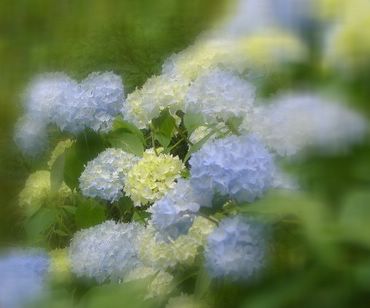 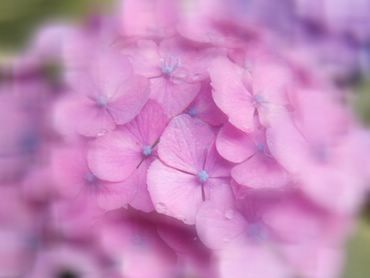 Wagashi by Ogasawara Categories: Wagashi |
Friday, June 30, 2006
Sweet Seasons/June 2006 - Hydrangea -

Thursday, June 29, 2006
Yamamomo
 Yamamomo Berries My boss gave me some yamamomo (myrica rubra or Japanese bayberry?) yesterday. This fruit is very popular in Kochi and used in various ways including desserts, jam and liquor. In my hometown, it is popular to make yamamomo-shu in the same way they make ume-shu (plum liquor), which is soaking the fruit and crystallized sugar in “white liquor” in a jar and waiting for about two months. Compared to ume-shu, yamamomo-shu has somewhat sweeter fragrance and a more pinkish color, and I like it mixed with some water and lots of ice.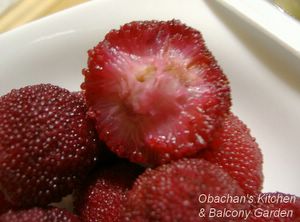 The left photo shows the inside of a yamamomo berry. I like eating yamamomo raw, too, with a little salt sprinkled on, but very ripe ones only. They are quite sour and even a bit astringent when not ripe, and eating such unripe ones can be unpleasant enough to make you want to stay away from them for the rest of your life. The left photo shows the inside of a yamamomo berry. I like eating yamamomo raw, too, with a little salt sprinkled on, but very ripe ones only. They are quite sour and even a bit astringent when not ripe, and eating such unripe ones can be unpleasant enough to make you want to stay away from them for the rest of your life.My boss gave me ripe and juicy ones (thanks, boss!) I enjoyed them after supper tonight , watching TV. Categories: Japanese, Kochi |
 Yamamomo
Monday, June 26, 2006
Bibingka
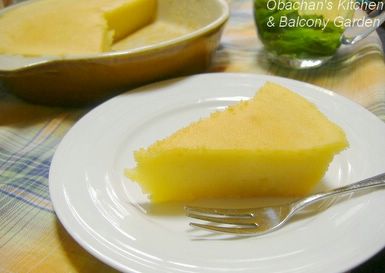 Bibingka Yesterday I finally tried out JMom’s bibingka recipe. When I read her post about this Filipino dessert, I got so curious because the recipe called for mochiko (rice flour) instead of regular flour. I HAD TO find out what it would taste like when mochiko is mixed with my favorite ingredients like coconut milk and sour cream. So I tried it -- and loved it very much! Looking at the photo in her bibingka post, I think the texture of hers looks more cake-like. My bibingka turned out pretty mochi-like, and I don’t know if it is the way it is or I made a mistake in conversion again or baking temperature was not correct or something. But I do love the taste. I bet kids would love this dessert with sweet, gentle aroma. It must be even better with banana leaves, which I can only imagine…  Thanks JMom for sharing the recipe! :D Categories: Asian-inspired, Sweets |
Saturday, June 24, 2006
Happy Saturday Night!
 Tacos (From Old El Paso Taco Kit) I had this sudden craving for Mexican food + beer at around 6:30 pm this evening. Maybe it had something to do with this weather today -- rainy in the morning, sunny and hot like summer in the late afternoon. So this was my supper tonight. Of course I had these tacos with (low malt) beer! :D In case you're wondering, I didn’t use ground meat for this Mexican treat, because I had some leftover chicken breast fillets. Yes, that’s what the brown thing on the plate is. Spicy food, cold beer and a movie on TV. Mmmmm…. Happy Saturday night. Right now I’m taking a little break before dessert. I just came to my laptop to share my happiness with you all. And ice cream is waiting for me in the freezer now, and my kitchen and living room are pretty clean and tidy because a guy from gas company came to check the gas range/water heater this morning, and tomorrow is Sunday! Yay!! OK. So much for now. Time for ice cream ;) Categories: Other-areas |
Friday, June 23, 2006
Mizuna and Sasami Salad
 Mizuna and Shredded Chicken Breast Fillet Salad My first harvest of mizuna turned into this salad today. Compared to the mizuna I see at stores, mine is a lot softer and the color is much lighter. 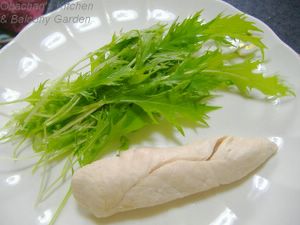 The mizuna and shredded chicken was tossed with wasabi-mayonnaise this time. It was one of a variety of mayonnaise dressings said to be good for mizuna salad. Other than the wasabi version, I saw mustard-mayonnaise, ponzu-mayonnaise, soy sauce-mayonnaise, sesame-mayonnaise, tofu-mayonnaise and mentaiko-mayonnaise, etc, etc… Wow! :D The mizuna and shredded chicken was tossed with wasabi-mayonnaise this time. It was one of a variety of mayonnaise dressings said to be good for mizuna salad. Other than the wasabi version, I saw mustard-mayonnaise, ponzu-mayonnaise, soy sauce-mayonnaise, sesame-mayonnaise, tofu-mayonnaise and mentaiko-mayonnaise, etc, etc… Wow! :DCategories: Western-inspired |
Thursday, June 22, 2006
Matcha and Azuki Separated...
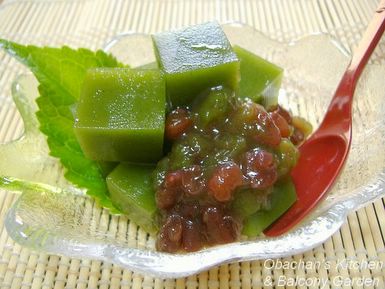 Matcha Mizu-Yokan If you are not familiar with tokoroten (agar noodles), this post tells you how we make/eat the noodles, as well as how my mom is involved in this tokoroten project (?!). OK, then, what is mizu-yokan? Here is a good explanation of what it is with a recipe and nice photo by Reid of Ono Kine Grindz. His recipe calls for kanten bars, of course. I bet any other yokan or mizu-yokan recipes call for kanten bars or kanten powder; no recipe would tell you to go to the beach and pick tengusa seaweed first. Of course not everyone lives near the beach, and the seaweed has to be dried for several weeks, but that’s not the only reason. For the better taste of kanten desserts, using kanten bars/powder is recommended over gelatin liquid just extracted from tengusa seaweed.  When we cook the seaweed to obtain the gelatin liquid, we add a little amount of vinegar. I’m not quite sure why, but they say that it probably won’t set well without the vinegar. Thus, the seaweed gelatin liquid is largely tasteless but has a slight hint of the flavor/smell of the seaweed and vinegar, which you don’t really want for your desserts. Kanten bars do not have that problem because such unwanted flavors are taken away during the repeated freezing process. That's why kanten bars are more ideal for making wagashi. When we cook the seaweed to obtain the gelatin liquid, we add a little amount of vinegar. I’m not quite sure why, but they say that it probably won’t set well without the vinegar. Thus, the seaweed gelatin liquid is largely tasteless but has a slight hint of the flavor/smell of the seaweed and vinegar, which you don’t really want for your desserts. Kanten bars do not have that problem because such unwanted flavors are taken away during the repeated freezing process. That's why kanten bars are more ideal for making wagashi.But looks like many housewives in my hometown did not care too much about such a minor(?) problem. If you cook tengusa seaweed once, you usually end up with quite a bit of gelatin liquid. If agar noodles was the only thing you can make out of it, you and your family will get tired of the noodles. Then why not go for more variety? Maybe you can hide the slight hint of the seaweed and vinegar by adding a lot of sugar and something with a strong flavor. Yeah, why not? So, in my hometown, it has been quite popular, when making agar noodles, to set aside some of the seaweed gelatin liquid and use it for making desserts like coffee-kan, umeshu-kan, nikkei cinnamon-kan and Soda-kan. For today’s experiment, I decided to go for mizu-yokan, and to give it a stronger flavor, I chose matcha mizu-yokan. Read More Now I'll show you how I made tokoroten and matcha mizu-yokan.      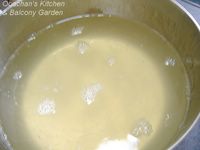 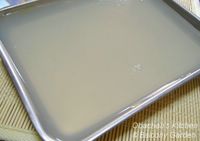 I drained it in a cloth bag, waited until it cooled a little, and while the seaweed was still warm, squeezed out the liquid as much as possible. The tengusa seaweed looked like this after squeezing (above left photo) and I got the tasteless and colorless gelatin liquid (above right photo). To make tokoroten noodles, the liquid needs to be poured in a flat container. What’s fascinating is that, unlike animal gelatin, kanten sets at room temperature and turns out very firm. But it tastes better when chilled, so I put it in the fridge after it was set. I drained it in a cloth bag, waited until it cooled a little, and while the seaweed was still warm, squeezed out the liquid as much as possible. The tengusa seaweed looked like this after squeezing (above left photo) and I got the tasteless and colorless gelatin liquid (above right photo). To make tokoroten noodles, the liquid needs to be poured in a flat container. What’s fascinating is that, unlike animal gelatin, kanten sets at room temperature and turns out very firm. But it tastes better when chilled, so I put it in the fridge after it was set.Now, from here, it gets in a real experimental phase. 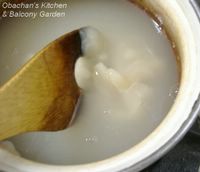 I added shiroan (sweetened white bean paste), sugar and pinch of salt to the remaining warm gelatin liquid and stirred well over low heat to dissolve them completely. In another bowl, I mixed matcha, sugar and a little hot water, then added some gelatin liquid and mixed well. The matcha mixture was then poured into the rest of the gelatin-shiroan mixture which had been removed from heat. When the whole mixture was properly flavored with matcha and colored dark green, I strained it through a sieve twice to remove tiny matcha lumps. So far, so good. I added shiroan (sweetened white bean paste), sugar and pinch of salt to the remaining warm gelatin liquid and stirred well over low heat to dissolve them completely. In another bowl, I mixed matcha, sugar and a little hot water, then added some gelatin liquid and mixed well. The matcha mixture was then poured into the rest of the gelatin-shiroan mixture which had been removed from heat. When the whole mixture was properly flavored with matcha and colored dark green, I strained it through a sieve twice to remove tiny matcha lumps. So far, so good. 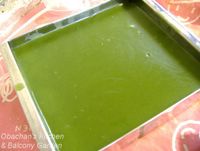 After a few hours, I sliced the mizu-yokan, and…  Ahhhhhh!!! That’s why I had to present it the way you see in the photo at the top of this post. With a hydrangea leaf, doesn’t it look somewhat like a hydrangea flower? :P Taste-wise, the matcha mizu-yokan was OK, since I couldn’t detect the taste of vinegar. But to tell you the truth, I felt a little strange aftertaste… or a slight sensation on my tongue. Maybe it was a vinegar effect? Next time I’ll try this with less vinegar and a less amount of non-mashed type of boiled azuki beans. Oh yes, there will be a next time, because I have plenty of dried tengusa seaweed left... Categories: Bloopers, Sweets |
Monday, June 19, 2006
Fresh Lemongrass Tea
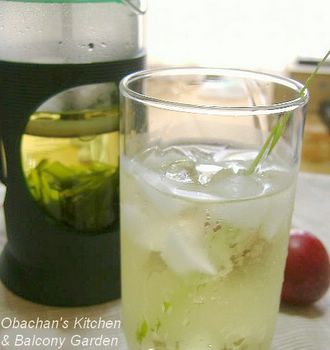 Fresh Lemongrass Tea (Iced)  I’m drying the rest of the lemongrass leaves. Categories: Drinks |
Saturday, June 17, 2006
Orange Chicken for a Lazy Day
 Orange Chicken for a Lazy Day This is something I whipped up today. I’ve been feeling lazy all day, with the depressing rain outside and all. I didn’t feel like cooking something elaborate, following the recipe precisely, step-by-step. So I just went through several orange chicken and sherry chicken recipes to get some basic ideas, and when cooking, I didn’t measure any of the ingredients with a measuring cup or measuring spoons. 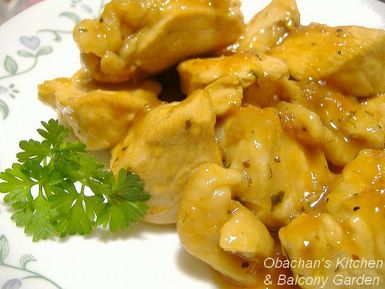  While making this dish, I kept telling myself, “These ingredients are all edible, so it’s not gonna kill me no matter how I mix them.” When I’m really lazy, this is often the bottom line of my cooking. :P While making this dish, I kept telling myself, “These ingredients are all edible, so it’s not gonna kill me no matter how I mix them.” When I’m really lazy, this is often the bottom line of my cooking. :PTo my surprise, this orange chicken was not bad. Maybe a little too sweet, but not bad at all. Now I'm feeling lazy to do the dishes... * OK. Now, here's the answer: I used mom's burnt orange jam for this orange chicken. Thanks for guessing! :D Categories: Asian-inspired |
Thursday, June 15, 2006
Weird Combination?
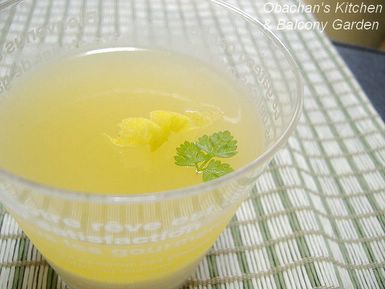 Konatsu and Soy Milk Jelly Another konatsu dessert with my dad’s konatsu oranges. The top layer is made with freshly squeezed konatsu juice, and the bottom layer with soy milk. Weird combination? I had to make them two-layered instead of just plain konatsu jelly – for esthetic reason :P  The soy milk was seasoned with sugar and some white rum. I thought about adding the liquor to the orange juice, but I finally decided against it because I preferred the fresh taste of konatsu as is. The soy milk was seasoned with sugar and some white rum. I thought about adding the liquor to the orange juice, but I finally decided against it because I preferred the fresh taste of konatsu as is.To me, the combination was not bad at all, honestly. Or…maybe… soy-milk jelly or panna cotta with konatsu sauce might have been a better idea. But I had much more kionatsu juice than soy milk and no cream in the fridge, so I guess this was a good choice in the given circumstance ;)  BTW, do you like these plastic cups? I saved them after we ate store-bought gelatin desserts (coffee jelly and mango jelly) in the office. Yep, the tropical-looking one had mango jelly in. Categories: Sweets |
Wednesday, June 14, 2006
Garden Report - June 2006 -
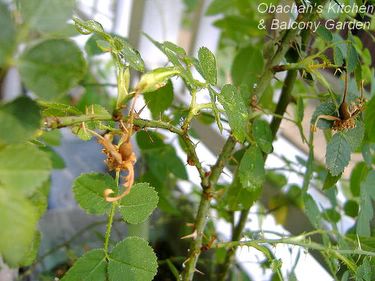 Remember how it looked just one month ago? All the leaves were green, looking completely healthy, and pink flowers were so lovely. Then it happened. At the end of May, some leaves started turning yellow. Then more and more leaves… When I looked close, I found tiny black spots on the leaves. This is a common rose disease, right? I used a fungicidal spray, and kept removing yellow leaves as much as possible every day, but obviously it was not enough for saving the flowers and hips from turning brown and falling. How disappointing… I heard that in other countries, dog rose just grows wild on the roadside, so I assumed that it was a disease-resistant kind which needs very little care. But with our hot and humid weather, it’s a different story here, I guess… Well, let’s not be too disappointed, because other plants are doing fine. 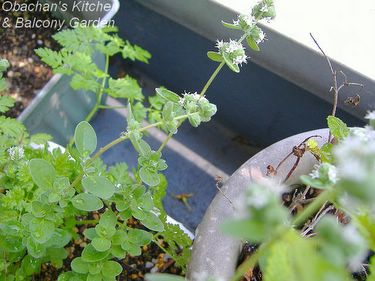 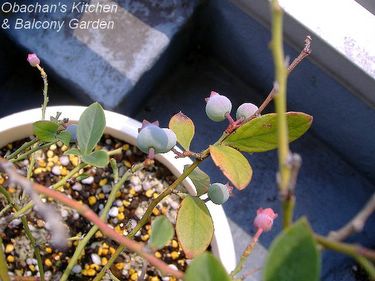 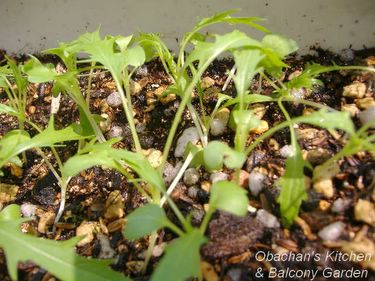 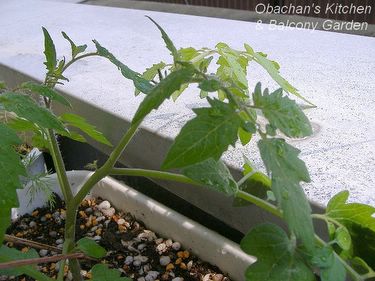 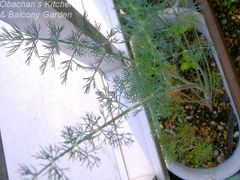 Dill is doing fine, as always. I’m hoping to be able to get more dill seeds than last year. Dill is doing fine, as always. I’m hoping to be able to get more dill seeds than last year.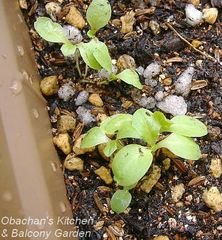 These are called “chima sanchu,” a variety of leafy lettuce(?) with long leaves and a little bitter taste. Well, that’s what I heard. They say it is great with yakiniku. Think about tasty yakiniku wrapped with crispy chima sanchu leaves… and accompanied by ICE COLD BEER!(← Very important.) :D These are called “chima sanchu,” a variety of leafy lettuce(?) with long leaves and a little bitter taste. Well, that’s what I heard. They say it is great with yakiniku. Think about tasty yakiniku wrapped with crispy chima sanchu leaves… and accompanied by ICE COLD BEER!(← Very important.) :D Categories: Garden |
Monday, June 12, 2006
Chicken and Dumplings
 Chicken and Dumplings When the humidity proves the beginning of the rainy season here, my memories of the South come back and I always feel the urge to make some southern dishes. Inspired by the Chicken and Dumplings entry by Randi of Culinary Adventures, I made this for lunch yesterday. When in the States, I always used Bisquick for making the dumplings. But I have read somewhere that for a real chicken and dumplings dish, the dumplings should be made from scratch. And now I’m fully convinced! Thank you Randi for sharing the recipe (and kindly coming over to my blog to let me know)! I enjoyed this very much. :) Categories: Western-inspired |
Look for a Moai...
|
 The chicken and dumplings recipe called for dry sherry, and it gave me a perfect excuse to buy my first bottle of it.
Saturday, June 10, 2006
Another Experiment and a Better-Than-Expected Result
 Jam & Cream Tarts and Cherry Tarts  Luckily, I have a good pastry cream recipe that one of the readers (she called herself "a fellow baker") gave me in her comment to my post about a year ago. I made the pastry cream over and over to try it with various kinds of fruits or jam, and I liked it every time. Most of the time I used heavy cream to make the half-and-half called for in the recipe, but this time I used vegetable whipping cream to make it lighter. Since mom’s jam had a little strong taste and slight bitterness, I thought rich cream might be overwhelming. Luckily, I have a good pastry cream recipe that one of the readers (she called herself "a fellow baker") gave me in her comment to my post about a year ago. I made the pastry cream over and over to try it with various kinds of fruits or jam, and I liked it every time. Most of the time I used heavy cream to make the half-and-half called for in the recipe, but this time I used vegetable whipping cream to make it lighter. Since mom’s jam had a little strong taste and slight bitterness, I thought rich cream might be overwhelming.These American cherries were bought for a back-up plan. If the test batch of the jam & cream tart would taste terrible, I was going to give up on the idea right away and make cherry & cream tarts with the rest of the pastry cream and tart shells.  So I made one test sample of each of the jam & cream version and cherry & cream version, and tasted both. And you know what?! They were both GOOD!! :D  So I made more of both kinds of tarts * Note that now I have chervil leaves to garnish my desserts. ;) Yep, they are from my balcony garden.  BTW, the shells are store-bought cookie tart shells. (No wonder they look good.) Categories: Sweets |
Friday, June 09, 2006
Colorless, but NOT Tasteless!
 Konatsu sorbet  I made this sorbet from dad’s konatsu oranges a few days ago. Too bad it looks so very colorless in these photos … The color of konatsu juice is light yellow, so there was nothing I could do about it. (Of course I didn't want food coloring.) I made this sorbet from dad’s konatsu oranges a few days ago. Too bad it looks so very colorless in these photos … The color of konatsu juice is light yellow, so there was nothing I could do about it. (Of course I didn't want food coloring.) Categories: Sweets |
Subscribe to:
Posts (Atom)