


 Maple and Ginkgo Leaves A Japanese wagashi site says that this semi-dry type wagashi is made by boiling water and sugar, grinding it with mortar and pestle until it turns white and thick, then adding kanten gelatin solution. After set, it is punched out with molds.  Since it has been rather warm this autumn, leaves didn’t turn colors until recently around here. Now I see the whole town colored with bright yellow and red everywhere, with some greens of evergreen trees. Maybe I should go for an photo-excursion this weekend, if the weather permits. ;) Categories: Wagashi |
Thursday, November 30, 2006
Sweet Seasons / November 2006 - Maple and Ginkgo Leaves -

Wednesday, November 29, 2006
Garden Report - November 2006 -
Here’s the update of my long-neglected garden report. :P Blueberry (Sunshine Blue) 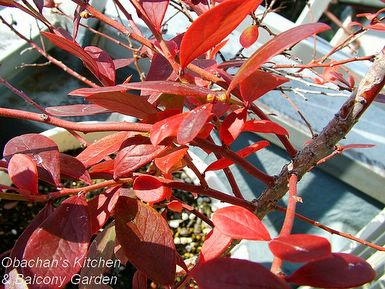 Parsley  Sweet Marjoram  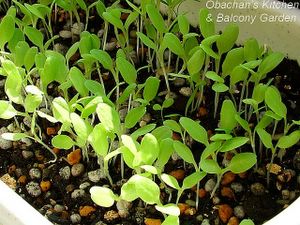  And this is the photo I took in summer, perhaps late July or early August, and forgot to post. I don’t think anyone remembers this, but seems like I did write something like “stay tuned for my dry tomato project this summer.” :P Well, it didn’t take place, because this was the one and only harvest I got. This is the pic of the tomato when ripe. And this is the photo I took in summer, perhaps late July or early August, and forgot to post. I don’t think anyone remembers this, but seems like I did write something like “stay tuned for my dry tomato project this summer.” :P Well, it didn’t take place, because this was the one and only harvest I got. This is the pic of the tomato when ripe.Categories: Garden |
Friday, November 24, 2006
Happy Thanksgiving!
 Kabocha Pumpkin Pie Absolutely no energy left for Thanksgiving dinner project this year. You know why. And I'm going to be in my hometown this weekend, helping mom with some kind of tea ceremony event there. I'm leaving early tomorrow morning. So, this was all I could do for Thanksgiving 2006. At least I baked this myself (after I came back from shooting photos of a steam locomotive) today.  Categories: Sweets |
Wednesday, November 22, 2006
Obachan's Quasi-Kaiseki #3
I guess my quasi-kaiseki is making a slow but steady progress. As you know, now I work at a kaiseki restaurant. Of course, there no one teaches a female dishwasher (me) how to cook, but I can see what chefs do, and later in my kitchen, I can ape what they do. What’s more, now I have this wonderful resource. So being fully inspired, I went through several challenges and did a bunch of aping.    先付 二種 Two Kinds of Sakizuke (Appetizers) 先付 二種 Two Kinds of Sakizuke (Appetizers)1.秋の前菜盛合せ Autumn Plate: 鶏肉柚子醤油焼き、きのこ肉詰め焼き、かまぼこ紅葉七味風味、そうめん松葉、いくら醤油漬、銀杏、銀杏芋 Broiled chicken marinated in yuzu-soy sauce, Mushroom meat balls, Maple-leaf shaped kamaboko (steamed fish cake) with shichimi pepper, Somen noodle pine leaves, Salmon roe, Ginkgo nuts, Ginkgo sweet potato 2. 胡桃豆腐 Walnut Tofu  お造り Otsukuri (Sliced Raw Fish) お造り Otsukuri (Sliced Raw Fish)ワカナ造り Young yellowtail  焼き物 Yakimono (Broiled Dish) 焼き物 Yakimono (Broiled Dish)チダイ西京焼き Broiled crimson sea bream marinated in miso (soybean paste)  蒸し物 Mushimono (Steamed Dish) 蒸し物 Mushimono (Steamed Dish)チダイ蕪蒸し Steamed crimson sea bream topped with grated turnip  揚げ物 Agemono (Deep Fried Dish) 揚げ物 Agemono (Deep Fried Dish)海老のコーンミール揚げ、シソ巻き鮭、サヤインゲン、ナス、ぶなしめじ、レンコン、かぼちゃ、銀杏、銀杏芋 Shrimp coated with cornmeal, Salmon and shiso (perilla) roll, String beans, Eggplant, Shimeji mushrooms, Lotus root chip, Kabocha squash, Ginkgo nut, Ginkgo sweet potato  酢の物 Sunomono (Vinegared Dish) 酢の物 Sunomono (Vinegared Dish)柿なます Vinegared persimmon and daikon strips  御飯・止め椀・香の物 Gohan, Tome-wan, Koh no mono (Rice, Miso Soup and Pickles) 御飯・止め椀・香の物 Gohan, Tome-wan, Koh no mono (Rice, Miso Soup and Pickles)しめじ御飯、味噌汁、カブの漬物柚子風味 Rice cooked with shimeji mushrooms, Miso soup, Pickled turnip flavored with yuzu citrus rind  菓子 Kashi (Dessert) 菓子 Kashi (Dessert)練り切り Nerikiri Categories: Japanese |
先付 二種 Sakizuke nishu (Two Kinds of Appetizers)
1.秋の前菜盛合せ Autumn Plate 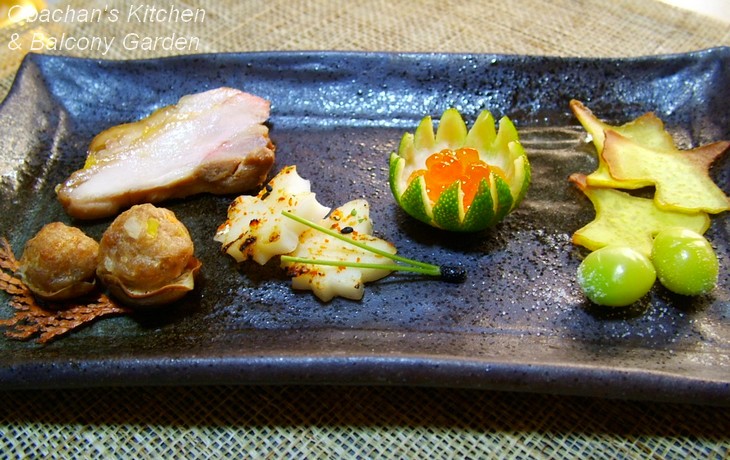 * *鶏肉柚子醤油焼き、きのこ肉詰め焼き、かまぼこ紅葉七味風味、そうめん松葉、いくら醤油漬、銀杏、銀杏芋 Broiled chicken marinated in yuzu-soy sauce, Mushroom meat balls, Maple-leaf shaped kamaboko (steamed fish cake) with shichimi pepper, Somen noodle pine leaves, Salmon roe, Ginkgo nuts, Ginkgo sweet potato * 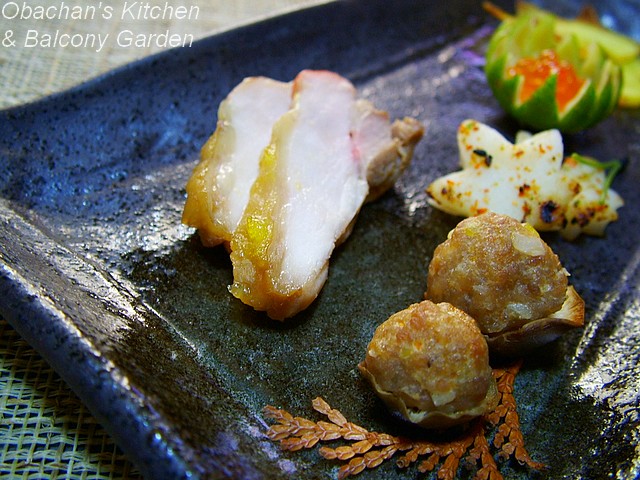 Broiled chicken: This was not a great success. The yuzu aroma faded pretty quickly and left the chicken rather bland. Broiled chicken: This was not a great success. The yuzu aroma faded pretty quickly and left the chicken rather bland.Mushroom meat balls: Aren’t they cute, looking like sawtooth oak acorns? The bottom parts are big Shimeji mushrooms. I didn’t expect the mushrooms to open up like this, but I think it’s cute. Maple-leaf shaped kamaboko: This is something that I whipped up. I sliced white kamaboko, brushed the surface with mirin & soy sauce mixture and burned it over the open flame of a stove top. Then I brushed the sauce again and sprinkled shichimi pepper. I wanted to brown the surface a little more, but I was worried about the shichimi pepper coming off, so I just punched the kamaboko with a maple-leaf shaped mold. *  Somen noodle pine leaves: This was so much fun to make! :D All you have to do is to break somen noodles into 5 or 6 cm lenghths, pick two, seal one end with tempura batter (I wrapped that part with dried seaweed) and deep-fry. The somen pine leaves will sink into the oil and immediately come up to the surface, slightly curved like real pine leaves. And they are done. Perhaps the only challenge would be finding green colored somen noodles. I shopped around quite a bit until I finally found a brand of somen noodles which had a couple of pink and green noodles in each bunch like this. I guess it is meant to add a little color to the noodle dish. Somen noodle pine leaves: This was so much fun to make! :D All you have to do is to break somen noodles into 5 or 6 cm lenghths, pick two, seal one end with tempura batter (I wrapped that part with dried seaweed) and deep-fry. The somen pine leaves will sink into the oil and immediately come up to the surface, slightly curved like real pine leaves. And they are done. Perhaps the only challenge would be finding green colored somen noodles. I shopped around quite a bit until I finally found a brand of somen noodles which had a couple of pink and green noodles in each bunch like this. I guess it is meant to add a little color to the noodle dish.Salmon roe in sudachi citrus cup: I’ve seen this in so many photos of traditional Japanese course meals, and I’ve always wanted to give it a try. The salmon roe seasoned with soy sauce was store-bought, but I did make this sudachi cup. Not bad, ha? Oh, wondering why these fish eggs have anything to do with autumn theme? Well, salmon lay eggs in autumn. ;) * Ginkgo nuts with salt: This year I didn't pop the nuts in microwave like I did last year so that I won't scare the neighbors -- hahaha. I cracked and removed the shells with pliers and microwaved the nuts for about 20 seconds. I did another trick with the salt to make it very fine and dry -- I microwaved it and then ground it with mortar and pestle. I saw the head chef doing this once in a while at the kaiseki place where I work at. The other chef told me that it makes the salt dry and fine. He said that tasty, “authentic” salt is usually quite moist, but with this trick, it becomes suitable for sprinkling or dusting. 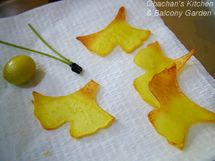 Ginkgo sweet potato: I got this idea from Mr. Murata’s Kaiseki book. My ginkgo sweet potatoes were not soaked in yellow coloring water as mentioned in the recipe in the book, but still looked yellow enough – at least when sitting on white paper. Ginkgo sweet potato: I got this idea from Mr. Murata’s Kaiseki book. My ginkgo sweet potatoes were not soaked in yellow coloring water as mentioned in the recipe in the book, but still looked yellow enough – at least when sitting on white paper.2.胡桃豆腐 Walnut Tofu  * *胡桃豆腐 Kurumi dofu Walnut Tofu  This was definitely a big -- or reckless -- challenge for me; I tried out the walnut tofu recipe in Mr. Murata’s book. It wasn’t a great success, as expected, but it wasn’t a crash and burn disaster, either. My walnut tofu didn’t set firm enough to be cut in a cube (I think I added wrong amount of kuzu starch) so I served it in this tiny cup. And I didn’t have the walnut oil which was called for in the recipe. So, what I made was probably very far from what it was supposed to be. I hope kaiseki chefs do not get mad at me for disgracing a famous chef's recipe... :P This was definitely a big -- or reckless -- challenge for me; I tried out the walnut tofu recipe in Mr. Murata’s book. It wasn’t a great success, as expected, but it wasn’t a crash and burn disaster, either. My walnut tofu didn’t set firm enough to be cut in a cube (I think I added wrong amount of kuzu starch) so I served it in this tiny cup. And I didn’t have the walnut oil which was called for in the recipe. So, what I made was probably very far from what it was supposed to be. I hope kaiseki chefs do not get mad at me for disgracing a famous chef's recipe... :PBut one thing is sure: trying out this recipe introduced me to a new combination of tastes that I didn't know before. This walnut tofu IS a delicacy. Indeed, grating sesame seeds and walnuts with a mortar and pestle was some work, but I understand that it had to be done that way. 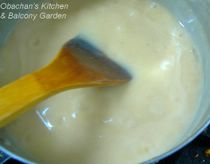 You can’t use store-bought sesame paste for this dish. And you MUST use good dashi broth taken from kelp and bonito flakes. Taking an easy way out would make a huge difference in the delicate taste of this dish. You can’t use store-bought sesame paste for this dish. And you MUST use good dashi broth taken from kelp and bonito flakes. Taking an easy way out would make a huge difference in the delicate taste of this dish.BTW, the black thing on top of my walnut tofu is a quartered piece of a grape. The walnut tofu in the kaiseki book was garnished with a few small grapes, so I wanted to do the same. But only bigger grapes were available at nearby supermarkets, and one whole grape was too big for my tiny tofu, so I quartered it. I left the skin on so that the grape would stand out on the dashi jelly poured over the tofu. Dashi-jelly and grape. What a combination! I’ve never thought about tasting those two together, but the combination was amazingly refreshing. Mmmmm.... My compliments to the person who invented this combination. 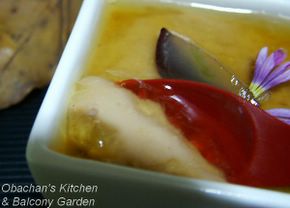 Categories: Japanese |
お造り Otsukuri (Sliced Raw Fish)
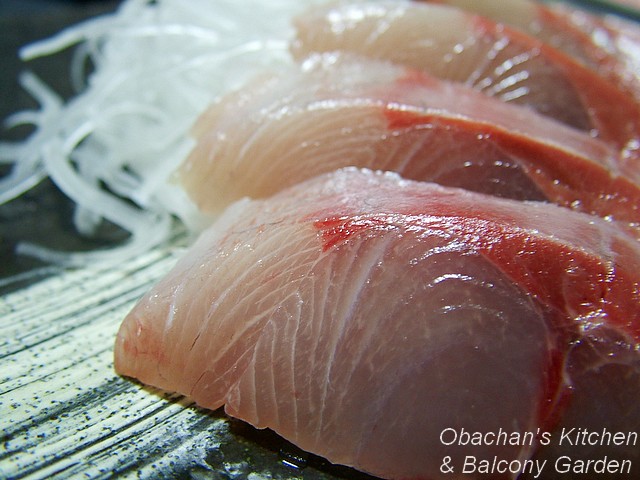 * *ワカナ造り Wakana tsukuri Young yellowtail  After gutting/filleting small fish (horse mackerels) frantically for a couple of months, I was ready for a challenge, i.e., a bigger fish. So I went for it. ;) After gutting/filleting small fish (horse mackerels) frantically for a couple of months, I was ready for a challenge, i.e., a bigger fish. So I went for it. ;)One funny thing in Japan is that some fish are given different names as they grow up. Yellowtail is one of the teasers. It is given 4 or 5 different names and the regional differences in the use of the names make things even more complicated. 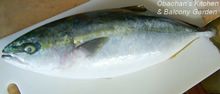 Gee, how could fishermen and sushi chefs handle that? This one was labeled as “Wakana” at the supermarket so I used the name here, but it may not be correct… Most websites I consulted said that wakana refers to young yellowtail around 20 cm or smaller, while the fish I bought was definitely bigger. Gee, how could fishermen and sushi chefs handle that? This one was labeled as “Wakana” at the supermarket so I used the name here, but it may not be correct… Most websites I consulted said that wakana refers to young yellowtail around 20 cm or smaller, while the fish I bought was definitely bigger. This is my sashimi bocho 刺身包丁(fish slicer). This is my sashimi bocho 刺身包丁(fish slicer). And I have to admit this: the close-up of the flesh of the fish looks much better than the vegetables I cut. Hence, this small photo of the garnish. I guess those who are familiar with traditional sashimi garnish would laugh at my work if they had a close look at the veggies I cut. To tell you the truth, this was the only yori-ninjin (twisted carrot strip?) that curled up properly. :P And I have to admit this: the close-up of the flesh of the fish looks much better than the vegetables I cut. Hence, this small photo of the garnish. I guess those who are familiar with traditional sashimi garnish would laugh at my work if they had a close look at the veggies I cut. To tell you the truth, this was the only yori-ninjin (twisted carrot strip?) that curled up properly. :PCategories: Japanese |
焼き物 Yakimono (Broiled Dish)
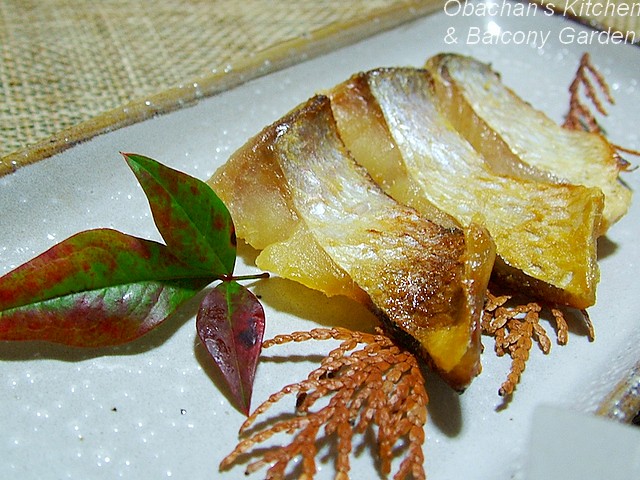 * *チダイ西京焼き Chidai saikyo-yaki Broiled crimson sea bream marinated in miso (soybean paste) As you probably know, I love grilled fish marinated in miso. Last year I tried it with yuzu-moromi miso, but this time I used shiromiso (white miso) to make Saikyo yaki. I heard that the name came from Saikyo miso, a kind of white miso that has very mild saltiness. Because of its mild taste, the miso is said to better preserve the good flavor of the fish marinated in it. I agree. This was just oh so HEAVENLY… Some saikyo-yaki recipes tell you to simply marinate fish fillet in white miso, while others require an extra procedure for making miso more flavorful. It is adding sake and mirin to miso and stirring well over a low heat. Of course, I'm a strong believer of the sake-and-mirin method. Here's a close-up. See the part with browned miso and imagine the wonderful aroma.  * *Categories: Japanese |
蒸し物 Mushimono (Steamed Dish)
 * *チダイ蕪蒸し Chidai kabura-mushi Steamed crimson sea bream topped with grated turnip    I don't think professional Japanese chefs would ever use same fish for both broiled dish and steamed dish, but I did so, due to the low-budget nature of my kaiseki project. ;P Anyway, this was my very first time trying out kabura-mushi, steamed fish with grated tunip topping. The dish is served with dashi-based soup thickened with starch poured all over. I don't think professional Japanese chefs would ever use same fish for both broiled dish and steamed dish, but I did so, due to the low-budget nature of my kaiseki project. ;P Anyway, this was my very first time trying out kabura-mushi, steamed fish with grated tunip topping. The dish is served with dashi-based soup thickened with starch poured all over.I said grated turnip, but actually whipped eggwhite is usually added to the turnip to make it white and fluffy. The ginkgo nuts and boiled lily bulb give a nice accent to the soft and smooth turnip topping, and the dashi soup brings the taste of the topping and sea bream together. It is an authentic dish that warms you up on a cold autumn/winter night. I wished I could have served this kabura-mushi in a bowl with a matching lid like this, but I don't have anything like that and I couldn't find one at the daiso 100-yen shop. * 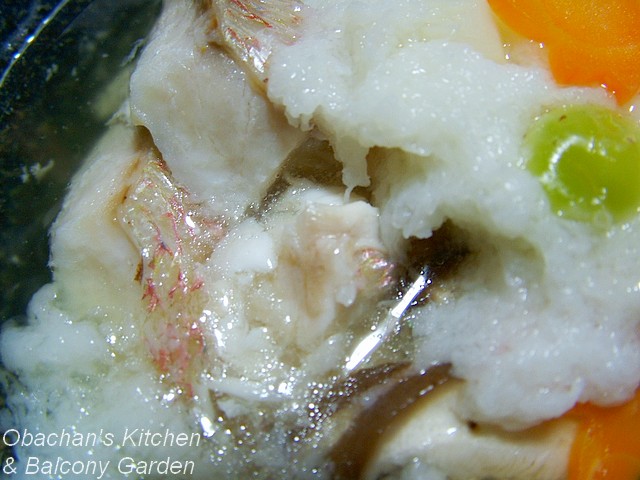 Categories: Japanese |
揚げ物 Agemono (Deep-fried Dish)
 * *海老のコーンミール揚げ、シソ巻き鮭、サヤインゲン、ナス、ぶなしめじ、レンコン、かぼちゃ、銀杏、銀杏芋 Shrimp coated with cornmeal, Salmon and shiso (perilla) roll, String beans, Eggplant, Shimeji mushrooms, Lotus root chip, Kabocha squash, Ginkgo nut, Ginkgo sweet potato  This used to be my basic tempura batter recipe. When I was making kakiage, I used 55 g flour as in this recipe, and when making regular tempura, I increased the amount of flour to 60 or 65 g. This used to be my basic tempura batter recipe. When I was making kakiage, I used 55 g flour as in this recipe, and when making regular tempura, I increased the amount of flour to 60 or 65 g.This time I tried something new to make crispy tempura -- I added rice flour and baking powder to the batter and didn’t use egg yolk. The result was not bad in terms of crispiness… but I think the batter tastes better with egg yolk. Tempura is often served with grated daikon and a lemon wedge in addition to the tentsuyu dipping sauce, but I prefer sudachi to lemon. BTW, before shooting the photo on top of this entry, I played around quite a bit putting the brown sprig here and there. I finally decided this was the best because I liked the shadow of the sprig on the white paper.  I think these bamboo sieve, brown sprig, ginkgo sweet potato and ginkgo nut look very nice and autumny together. This is my favorite shot. I think these bamboo sieve, brown sprig, ginkgo sweet potato and ginkgo nut look very nice and autumny together. This is my favorite shot.Categories: Japanese |
酢の物 Sunomono (Vinegared Dish)
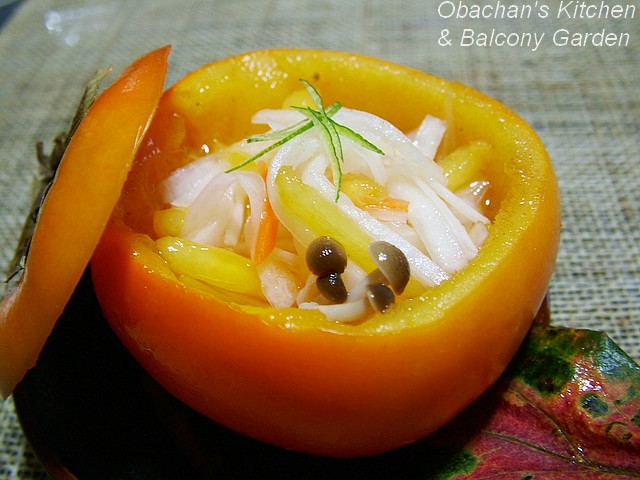 * *柿なます Kaki namasu Vinegared persimmon and daikon strips I couldn't find a nice bowl for serving this dish, (the one I had in mind was used for walnut tofu) so finally I decided to use the persimmon as a serving bowl. How's this idea? The dressing I used was the mixture of 2 Tbsp. vinegar, 1 Tbsp. sugar, a few drops of light soy sauce and just a little bit of wasabi. It was nice, but to be perfectly honest, the persimmon bowl tasted better than the sunomono itself… :P 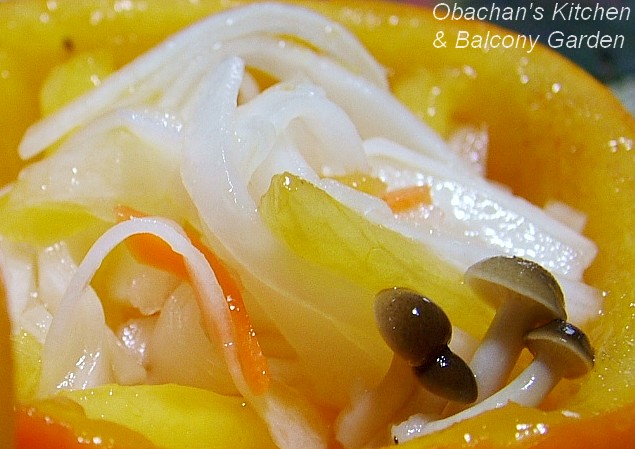 * *Categories: Japanese |
御飯・止め椀・香の物 Gohan, Tome-wan, Koh no mono (Rice, Miso Soup and Pickles)
*  しめじ御飯、味噌汁、カブの漬物柚子風味 Rice cooked with shimeji mushrooms, Miso soup, Pickled turnip flavored with yuzu citrus rind  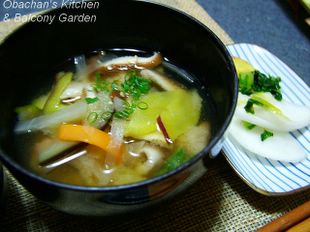 Categories: Japanese |
菓子 Kashi (Dessert)
 * *練り切り Nerikiri (What should I name this? Any idea?) Now I’m very proud of the progress I made. This was the nerikiri I made in autumn 2005. Just like a kid’s work with playdough, isn’t it? Now look at the top photo, my best work this time. What do you say? A teenager’s work with playdough, maybe? ;P I tried making a color gradation with white and orange dough, and I think I did a good job for the first try.  Nerikiri is basically sweetened white bean paste, but often yam or gyuhi is added to make it smooth and flexible. Last year I tried adding steamed yam, so this time I tried adding gyuhi. Gyuhi is made by mixing mochiko (rice flour), water and sugar over a low heat. The trick I used this time was adding a little egg white when mixing rice flour and water. I read somewhere that egg white is often used to make wagashi whiter, and somehow I thought it would be better to mix it with gyuhi than with the bean paste, though I can’t really tell you why. Anyway, it seems to have worked. Nerikiri is basically sweetened white bean paste, but often yam or gyuhi is added to make it smooth and flexible. Last year I tried adding steamed yam, so this time I tried adding gyuhi. Gyuhi is made by mixing mochiko (rice flour), water and sugar over a low heat. The trick I used this time was adding a little egg white when mixing rice flour and water. I read somewhere that egg white is often used to make wagashi whiter, and somehow I thought it would be better to mix it with gyuhi than with the bean paste, though I can’t really tell you why. Anyway, it seems to have worked.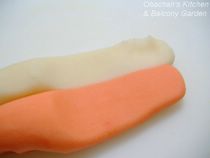 The technique of making a color gradation is called “bokashi.” You combine two pieces of dough in different colors and roll them out together. Then you fold it and roll it out again, as described in this site. (Scroll down to find the bokashi part). Notice that the borderline between the two colors in the upper half is not brought exactly onto that in the lower half. This slip is what that makes the color gradation. The technique of making a color gradation is called “bokashi.” You combine two pieces of dough in different colors and roll them out together. Then you fold it and roll it out again, as described in this site. (Scroll down to find the bokashi part). Notice that the borderline between the two colors in the upper half is not brought exactly onto that in the lower half. This slip is what that makes the color gradation.It was so much fun playing with the color, and the texture of this gyuhi-mixed one was 100 times better than what I made last year. Honestly. With nice, hot green tea, this nerikiri made a perfect dessert to conclude my kaiseki project in autumn 2006. 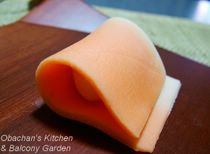  ---- So this was obachan’s crazy kaiseki weekend in November 2006. Hope you enjoyed it as much as I did ;) Oh, if you don't mind, can you tell me which dish you liked the best and why? Categories: Japanese |
Subscribe to:
Posts (Atom)