I went to my hometown over the long weekend (last Saturday, Sunday and a national holiday on Monday) because it was
obon period there, a time for family reunion. Unusual? Yes. I guess the majority of Japanese celebrate this event in mid August. My hometown is one of the exceptional places. Also, there is no such customs as obon-dance or lantern floating in my hometown, so unfortunately I don’t have much to share with you about “typical” Japanese obon customs that you might have heard of.
My family cooks special meal for the ancestors called “
oryogo,” and brings food gifts to close relatives to offer to their ancestors. That’s about it.
Oryogo. At my parents’ house, this special meal is offered to ancestors during obon and ohigan (equinoctial weeks in spring and autumn).
Since Buddha taught people not to kill animals, traditional ceremony food of this religion is almost always strictly vegan. Mom's
oryogo this time consisted of cooked rice, tea, water, simmered foods including Japanese pumpkins, black mushrooms, carrots, myoga ginger, flower-shaped “fu (wheat gluten),” and pickles. In the morning, mom or I bring this meal to the family altar, light incense sticks, ring the bell twice and pray VERY briefly. This meal is supposed to be offered to the ancestors before we eat breakfast, but often things don't go straight and family members have to wait with their breakfast on the table while I struggle to pat the cooked rice into a dorm-shape in those tiny bowls. And as soon as the bell is heard, those at the table start eating breakfast. ;P
Later (usually at lunchtime) the meal is taken back from the altar to be shared by the family members. It is said that eating
oryogo meal will make you healthy (perhaps because the meal absorbs some magical power from being at the altar for a while???)
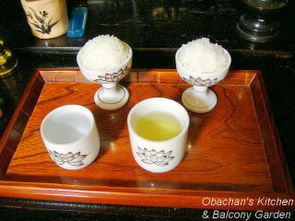
This photo shows the regular meal offered to the ancestors at my parents’ house. (See how gorgeous the obon version is compared with this regular meal?) Every time rice is newly cooked, a small amount has to be offered to the ancestors first before we eat it. But our family members are awfully flexible, as you might have already recognized from my previous posts on this blog. Sometimes, when we are extremely busy, we say “Sorry!” to the ancestors in our hearts and eat newly cooked rice without offering any to them. Fortunately, we haven’t heard any complaints so far. ;)
Other than the
oryogo meal, we (at least in my hometown) offer sweets and fruits to the ancestors during obon period. This colorful sweet called
rakugan is a staple of obon.
--------
That weekend, mom and I went for shellfish hunting, because we couldn't do that in May. Nothing stopped us this time. :D The weather was nice -- though a little too hot -- and the waves were not rough at all. And see what I got!
That night, I barbecued the abalones with sake, soy sauce and a dash of yuzu vinegar. Sounds good? Well… they were very fresh indeed, but to be honest, they were not as tender as I wanted them to be. I guess I prefer smaller abalones for barbecuing.
Mom also picked bunch of
tengusa seaweed on the beach
AGAIN. In summer,
tengusa is washed up on the beach like this with other seaweed, so all you have to do is to selectively pick what you want from the mixture of slimy plants. Well, when mom does something like that, she is driven and nothing can stop her. I had to beg her so many times to go home.
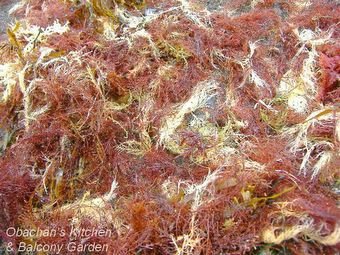 Tengusa on the beach
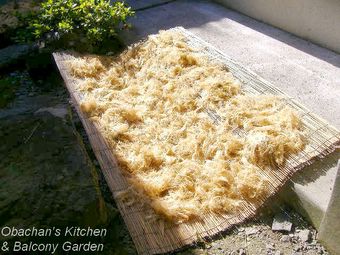 Tengusa being dried at my parents' house
 If you would ever come to my hometown, you can see the
tengusa being dried here and there at this time of the year. It is the same old scene there. Local folks dry the seaweed until it turns beige, then sell it to the local fishery association. (I don’t know how much they pay.)
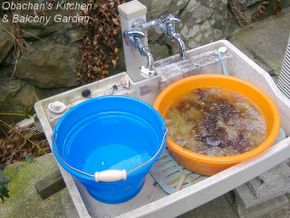
This is an outdoor sink at my parents' house. Most of the houses in the coastal area have a sink like this in the backyard. It's convenient for gutting big fish or soaking swimming goggles in water or leaving the catches from the ocean while washing feet to go inside the house. Remember, we do not wear shoes in the house in Japan. So if we got our feet wet from catching something in the ocean, we have to wash and dry our feet before getting inside the house in order not to make a mess on tatami mats and wooden floor. The floor has to be kept clean for us to walk on without wearing shoes.
Anyway, the fact I'm trying to ignore is that there is going to be a new addition to mom’s stock of dried
tengusa, maybe followed by some more additions before the end of this
tengusa season...
Ahhhh....!


 First, wash the beans and cut off ends. This is to let the beans absorb salt better. (According to them,
 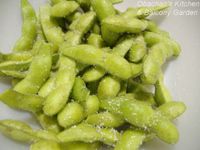 Place
Place  Boil for 3 to 5 minutes. Do not boil more than 5 minutes because the beans will lose amino-acids which are supposed to make them taste good. Some websites say that the beans turn out greener if boiled with the lid on. Others say do not close the lid because some volatile acid from the beans will stay in the pot and ruin the taste. (I put the lid on but did not close it completely.)
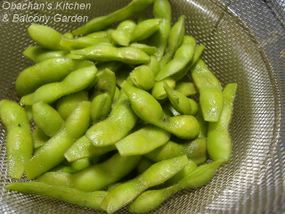 Drain and cool by fanning. It is not recommended to dip them in cold water to cool, because it would wash off some salt and make the beans rather soggy.

 When I found some apricots in the “discount” section of a supermarket yesterday, I thought I was really lucky, because we don’t see fresh apricots around here very often. The ones I found did not look ripe but already turning brown here and there, so they were obviously meant to be cooked/baked with lots of sugar.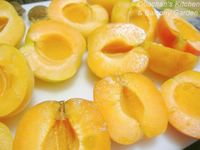


 I think I have seen something like this on the net before… I mean, putting some kind of spread on a rusk (melba toast?) and topping it with a rosemary sprig. It looked so nice that I have been wanting to recreate it someday, and finally the “someday” came. Maybe this combination of cream cheese, apricot jam and rosemary is rather strange, but I was quite satisfied … visually. The taste? It was... OK. :)


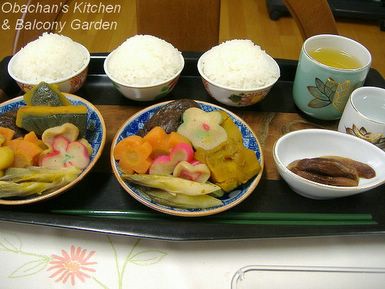
 This photo shows the regular meal offered to the ancestors at my parents’ house. (See how gorgeous the obon version is compared with this regular meal?) Every time rice is newly cooked, a small amount has to be offered to the ancestors first before we eat it. But our family members are awfully flexible, as you might have already recognized from my previous posts on this blog. Sometimes, when we are extremely busy, we say “Sorry!” to the ancestors in our hearts and eat newly cooked rice without offering any to them. Fortunately, we haven’t heard any complaints so far. ;)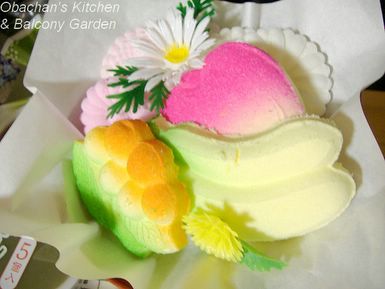


 This is an outdoor sink at my parents' house. Most of the houses in the coastal area have a sink like this in the backyard. It's convenient for gutting big fish or soaking swimming goggles in water or leaving the catches from the ocean while washing feet to go inside the house. Remember, we do not wear shoes in the house in Japan. So if we got our feet wet from catching something in the ocean, we have to wash and dry our feet before getting inside the house in order not to make a mess on tatami mats and wooden floor. The floor has to be kept clean for us to walk on without wearing shoes.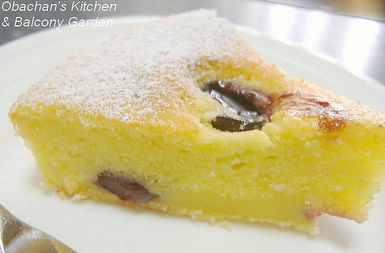
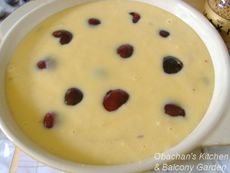 I have to admit that my cake didn’t have as many cherries as hers. Well, American cherries are rather expensive around here. But still the result didn't disappoint me.
 I soaked the cherries in sherry for 15 to 20 minutes beforehand as someone mentioned in her comment to LPC’s post. (Yes. What's in the photo is halved cherries in sherry.) It was definitely a good idea, as I had expected. Also I added a twist or two of my own—I replaced about 1/3 of the flour with almond powder, and used soy milk in place of milk. And the result was a scrumptious combination of soft, moist and rich (but not heavy at all) cake and refreshing cherries!



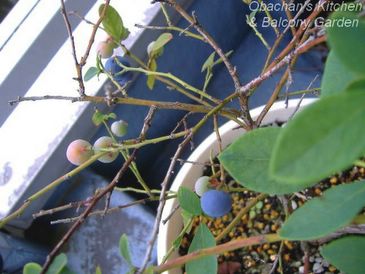

 Yes, my mom’s neighbor did not lie. I see an oblong tomato growing. Stay tuned for the progress of my dry tomato project this summer!

 Now as an adult, I enjoy sake once in a while, but until recently I always drank the same local brand, Tosazuru 土佐鶴, non-expensive, regular version (futsu shu) only. And when I go out with my friends, usually sake is not my first choice of drink. After all, beer and cocktails are far more commonly served at parties and karaoke places.


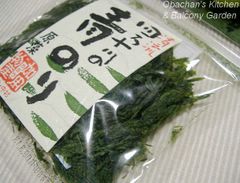 Some people may not like this
 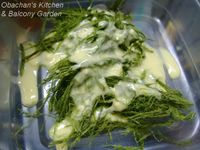 This tempura is also very easy to make. All you have to do is pour a little batter over the green laver and mix, take a little portion of it and flatten with fingers, then drop it in hot oil to deep fry. It is very important to make it as flat as possible so that it turns out pleasantly crunchy.