


 Odairi-sama and Ohina-sama (Male and Female dolls representing the Emperor and Empress) by Nishigawaya Japanese doll festival held on March 3rd is called Hina-matsuri. Hina dolls are traditional ornamental dolls used for this festival only. For more details about Japanese doll festival, see this site. The hina dolls are supposed to be taken down and put back in the boxes as soon as the festival is finished, because there is an old saying that if you have the dolls on display for too long, the girl(s) in the family will marry late. Now you know the reason why I'm still single: my family was lazy after the doll festival. ;)  I really love these cute wagashi hina dolls. They do look like a man and woman in kimono.   They are in love. ;) To some wagashi and tea ceremony learners or experts living in and outside I’m sorry that I cannot give you, at this point, a decent explanation about what these cute dolls are made with. I’m sure these are made with shiro-an (sweetened white bean paste) based dough, but not sure if it is nerikiri or konashi. Again, I forgot to ask the clerk at the store. I’m not sure what the difference between nerikiri and konashi is in the first place, if there is a difference anyway. Some even say that they are the same thing called differently in different areas in Categories: Wagashi |
Monday, March 31, 2008
Sweet Seasons / March 2008 - Hinamatsuri (Doll Festival) -

Sunday, March 30, 2008
Garden Report - March 2008 -
 Blueberry (Sunshine Blue)  Mitsuba  Sunshine Blue again ....................................... Spring has come. .......................................... ;) Categories: Garden |
Tuesday, March 25, 2008
* Happy Birthday to Me *
 My Homemade Birthday Cake Pink has never been my favorite color. When I took photos of my birthday cakes with flowers in previous years, I never used pink flowers. However, I do love the delicate pinkish white of cherry blossoms. I can never fully explain how much I love to see that color in spring -- the season when everything looks fresh and alive.  Usually cherry trees start blooming in late March around here, but I don’t see too many of them around my birthday. That is why it never occurred to me to relate my birthday to that beloved blossoms. But this year, because of the warm weather, some cherry trees in this neighborhood are already in full bloom now. And as I was riding my bike enjoying the view of such early blossoms yesterday, I thought, “Maybe the day I was born was a warm, sunny day like this, and some cherry trees might have been in half-bloom then, if not full-bloom.” Usually cherry trees start blooming in late March around here, but I don’t see too many of them around my birthday. That is why it never occurred to me to relate my birthday to that beloved blossoms. But this year, because of the warm weather, some cherry trees in this neighborhood are already in full bloom now. And as I was riding my bike enjoying the view of such early blossoms yesterday, I thought, “Maybe the day I was born was a warm, sunny day like this, and some cherry trees might have been in half-bloom then, if not full-bloom.”I remember that there were a couple of cherry trees near my parents’ house, including the big one at the gate of our local shrine. I have heard from mom that when she gave birth to me, it was not easy because I was a breech baby. So when I was born safely, someone in my family must have run to the relatives’ house to tell the good news (because we didn't have the phone at that time yet. Ahem!) and visited the shrine to thank God on his/her way home. That “someone” might have looked up the cherry blossoms blooming in the spring sunshine, with the blue sky in the background, and felt rejoiced. When I thought about that, I suddenly felt like making a birthday cake with cherry blossoms.  Actually, using cherry blossoms for baking is not such a crazy idea. Recently I see more and more sakura (cherry blossom) cakes and cookies being sold at the stores as well as their recipes shared on the net. You think we make jam out of the blossoms and use it for baking? No.  Usually we use salted cherry blossoms or liqueur flavored with the blossoms. For the cake I made this time, I used the sakura liqueur to flavor the top layer and sank some salted sakura in it. The white layer is the mixture of canned white peach and yogurt set with gelatin, and the bottom is a graham cracker crust. The original recipe (Japanese) is here. Usually we use salted cherry blossoms or liqueur flavored with the blossoms. For the cake I made this time, I used the sakura liqueur to flavor the top layer and sank some salted sakura in it. The white layer is the mixture of canned white peach and yogurt set with gelatin, and the bottom is a graham cracker crust. The original recipe (Japanese) is here.As you can see in the photo on top of this post, the pink layer of my cake was a bit too soft and the edges didn’t turn out as sharp as I wanted. I was too lazy to buy gelatin sheets (leaf) and used regular gelatin powder, thinking that it would turn out firm enough if I refrigerate the cake longer than recommended in the recipe. Wrong! :P Now I know that there was a good reason for using different kinds of gelatins for those layers: sheet (leaf) for the top layer and powder for the white layer.  I tried to hide the ragged edges with whipped cream, but obviously it wasn't a good idea... :P So I can't say that this was a great success. But there’s something I like so much about this cake – maybe the color combination? – and I'm glad that I chose to make this one for my birthday 2008. (I might try another sakura cake sometime soon...)  ----- Let me add a little more about the aroma of the cherry blossoms. It’s kind of tricky. I don’t think that the blossoms themselves have such a distinctive fragrance like roses or plum blossoms do. When most Japanese smell things like incense, soap, cologne or sweets with “cherry blossom fragrance,” we are not associating it with the smell of the blossoms on the tree; actually we are associating it more with the smell of a Japanese wagashi called Sakuramochi. The smell of sakuramochi comes from the salt-preserved cherry leaf wrapped around the rice cake, and according to some scientific websites, the smell is caused by a substance named “coumarin“ which is contained in the cherry leaves. They say that the substance does not produce the smell while in the live cherry leaves, but does so when the leaves are salt-preserved. Interesting! Now, many Japanese kids hate sakuramochi because of its smell, and I was one of them, too. I don’t know how to describe the smell… it is somewhat sweet, but different from typical floral fragrance. It’s more… how shall I say… starchy? I don’t know… Anyway, I would say that whether you love sakura-flavored sweets/drinks really depends on whether you can truly love the smell of coumarin or not. (I’ve read that Polish vodka called zubrowka has the coumarin smell, too. So don't be surprised if a Japanese who smelled zubrowka would say, "Gosh, this smells like a cherry blossom rice cake!") Now, being an adult, I don’t hate that smell of salted cherry leaves any more –- I even love it. But let me warn you… If you are interested in trying out some cherry-blossom flavored sweets/drinks, don’t feel too discouraged if you find them quite different from what you expected. ;) Categories: Sweets |
Friday, March 21, 2008
Photogenic but...
 Sea Bream Carpaccio I think this carpaccio looks pretty healthy and maybe tasty, too? But the truth is that it didn't taste as good as it looked. My mistake was using a buntan for this dish. Yes, the citrus fruit from my dad's garden. As I wrote in my previous post, buntan looks like grapefruit but its flesh is firmer and dryier tnan that of grapefruit, so when we (my family members) eat it, we usually tear and open up each segment like this photo below and bite the flesh off from the membrane. And we call the opened-up segment "baby chick." Cute, ha?  Anyway, for this carpaccio, I made a simple sauce with olive oil, vinegar, garlic, salt and black pepper. Then I added some freshly-squeezed buntan juice, thinking that citrus juice would give a refreshing kick and go well with the sea bream. But I was too lazy to take the flesh out of the segments and squeezed the flesh and white parts together, so the sauce turned out a little bitter because of the bitterness from the pulp(?).  I also added some chunks of buntan flesh to the vegetables. Actually this was not a terrible idea, I would say. The sauce and the citrus chunks tasted pretty good together. But I just thought the buntan and the sea bream would definitelly taste better when eaten separately, and couldn't see any reason why they should be mixed together like this. Hahaha...  Nevertheless, they look nice together in these photos, I think... ;) Oh, BTW, this sea bream is not the one in the photos in my last post. I bought a pack of sea bream sashimi for this carpaccio. Categories: Western-inspired |
Monday, March 17, 2008
The Supermarket Chronicles - Part 2 -
 Now, big sea breams are very expensive fish which are used for various celebrations, and preparing them for celebration feasts require real professional skills because their bones are extremely tough and some have poison in their fins. It would be quite a while before I start practicing on such big ones, but for now I’m happy with being able to prepare these small ones. After the work that day, I bought two small sea breams and reviewed, in my kitchen, what I learned. I took these photos then. Yes, I'm working on a new project, too. I want to become able to take beautiful photos of fish and other seafood -- not just the fish/seafood dishes, but including fresh fish and seafood themselves. I think sweets are very photogenic, and so are some vegetables. But fish and seafood can look quite plain or even grotesque sometimes, so for me it's harder to take good-looking photos of them. Now I'm going to practice and experiment this and that in order to capture the beauty of those friends from the ocean. It must be an enjoyable challenge. Wish me luck. ;) Categories: Supermarket |

Thursday, March 13, 2008
Susan's Tofu Quiches
 Tofu Quiches It was more than a year ago when I read about this creative tofu quiches on Fatfree Vegan Kitchen, and I finally tried it out the other day. Unfortunately I couldn't get nutritional yeast over here. (Actually I had absolutely no idea what it was. I was almost going to use regular active dry yeast, and I'm really glad that I didn't.) So I used good amount of shredded cheese, thus my quiches were by no means "fat-free." But I really loved them. :) Categories: Western-inspired |
Thursday, March 06, 2008
Udon Dashi (Tsuyu)
 Tsukimi Udon (Udon noodles with an egg on top) If you like Japanese food, or have made Japanese dishes yourself, you probably know or at least heard of dashi broth. The word dashi usually means unseasoned stock made by boiling things like kelp, bonito flakes, dried baby fish or mushrooms. Sometimes it can mean seasoned broth for noodle dishes, as in the title of this post, but maybe the word tsuyu is more commonly used in that case. As some of you may know, in Japan, the region covering Tokyo (capital) and several surrounding prefectures is called Kanto, and that covering Osaka and neighboring prefectures is called Kansai. And broths of udon noodle dishes in Kanto and those in Kansai are distinctively different. The Kanto version and Kansai version have been considered as two major types of udon broths in Japan, and (I suppose) udon broths in other regions have been roughly categorized in either of those two. The difference? Well, take a look at this website of a popular Japanese TV show. What’s in those bottles are udon broths collected from different regions in Japan. (A staff rode a west-bound bullet train from Tokyo and ate udon to collect broth samples at the stalls on the platform at the major stops. :D) The bottle at the far right is udon broth from Tokyo, and it goes west as it goes to the left. You see the color difference? It is said that in Kanto, they use mainly bonito flakes to make the dashi stock, and then season it with generous amount of regular soy sauce which makes the broth dark brown. On the other hand, in Kansai, more kelp and even dried baby fish are used to make stock in addition to bonito flakes, and often their bonito flakes are not the thinly shaved ones usually used for Japanese traditional clear soup.  The above photo is the thinly shaved bonito flakes usually used for traditional clear soup. But I heard that they use much thicker bonito flakes for Kansai udon broth and even mix flakes of a few different kinds of dried bonitos. And the most important seasoning ingredient is LIGHT soy sauce. Yes, it's got to be light soy sauce. Now, have you noticed that I kept writing “it is said,” “they say” and “I heard” in above passages? Here’s my confession: I had never made udon broth from scratch until this time -- I always used instant udon dashi mix. And my mom did so, too. Even though I have lived in Kansai region for apx. 20 years, I never knew exactly what they used for making udon dashi there. Thus, what's in the photo below are the udon broth ingredients I bought this time, based on the knowledge I have gained from the Internet. :P  See how thick the bonito flakes are? Well, the broth I made with these ingredients and the seasonings in the recipe below tasted pretty close to the udon broth I had in Kansai and here in Kochi, so I think I’m on the right track. Now, thanks for your patience. Finally, here's the recipe I came up with by conbining a couple of Kansai udon broth recipes on the net. Udon dashi (tsuyu) recipe, Kansai type * For making the stock (for 2 to 3 servings?) 1700 mL water 20 g dried baby fish 30 g dried kelp 30 g bonito flakes (thick type, mixture of different kinds, if available)  Put 1700 mL water, dried kelp and dried baby fish in the pot. Leave for more than 30 minutes. (Remove the heads and guts of the dried fish beforehand if you want the broth milder.) Heat over low heat for 10 to 15 minutes and take out the kelp before it starts boiling. (DO NOT boil the kelp, or the slimy stuff from the kelp will really ruin the flavor of the broth!) Turn the heat to high and add bonito flakes and boil for about 5 minutes, if used thick bonito flakes (and maybe 3 minutes if used thin bonito flakes). Drain. * The photo shows how I drain it. ---> Put 1700 mL water, dried kelp and dried baby fish in the pot. Leave for more than 30 minutes. (Remove the heads and guts of the dried fish beforehand if you want the broth milder.) Heat over low heat for 10 to 15 minutes and take out the kelp before it starts boiling. (DO NOT boil the kelp, or the slimy stuff from the kelp will really ruin the flavor of the broth!) Turn the heat to high and add bonito flakes and boil for about 5 minutes, if used thick bonito flakes (and maybe 3 minutes if used thin bonito flakes). Drain. * The photo shows how I drain it. --->* For making udon dashi broth (for 2 to 3 servings?) 1000 mL dashi stock 1 teasp. salt 1+1/2 Tbsp. light soy sauce 1+1/2 Tbsp. mirin Heat dashi stock, add seasonings. Add boiled udon noodles and cook for a couple of minutes. Serve with your favorite toppings such as minced green onions, wakame kelp, slices of kamaboko or sumaki (steamed fish cake products), tempura, tenkasu (tempura batter flakes) and shichimi pepper. * If you are interested in making udon noodles yourself, see this website. Now, as some of you readers have brought up in the comments, there is another place that you cannot miss when talking about udon culture in Japan. It is Kagawa prefecture known as Sanuki in olden days, and their thick-n-chewy Sanuki udon noodles are made by putting the udon dough in plastic bags and stepping on it to knead it with heels. And the key ingredient of their udon broth are dried baby sardines called iriko and their local light soy sauce. Those facts were already known (at least, among some people) in other areas in Japan, too, but what really made Sanuki udon -- as well as the udon culture in Kagawa prefecture -- popular throughout the country were probably this book, "Osorubeki Sanuki Udon" and this recent(?) movie called “UDON.” Thanks to the media attention, recently some people even dare to add a third category, "Sanuki udon broth" to the big two, Kanto and Kansai versions, and say that Sanuki version is a bit saltier and lighter-colored than Kansai broth.  Unfortunately I have never had a chance to eat udon in Kagawa, but rumor has it that there are more udon noodle shops than traffic lights over there, or Kagawa natives only eat udon for lunch, or local people bring their own udon bowls and chopsticks to local udon noodle manufacturers (small, mom-and-pop type places) and enjoy old-fashioned good udon dishes which are not available at regular restaurants, etc. etc. And the place I’m interested in the most is this hilarious udon school where they teach you to dance on the udon dough to knead it. I’m not kidding. Believe me. Lucas of Nihon no Ryori actually gave it a try there. And here is another post about the udon school. Looks like a lot of fun, right? But even before they wrote about it, the taste of Sanuki udon must have been already introduced outside Japan, because someone picked it as one of “The Top 50 things every foodie should do” in 2005. How flattering. ;) Categories: Japanese |
Friday, February 29, 2008
Sweet Seasons / February 2008 - Shitamoe -
 Shitamoe -- Grass Sprouts (under the snow) by Shingetsu Shitamoe is a popular wagashi motif for early spring. The word shita means "under" or "underneath" and moe, "sprouting" or "shooting out." In the photo above, you see the green between the brown and white parts? It is symbolic of sprouts coming out from the dark, winter soil underneath the snow. Japanese people have loved the liveliness of grass sprouts as an early sign of spring and the word shitamoe has been widely used in Japanese traditional poetry.  If I'm not mistaken (because I forgot to ask at the store and now I'm writing this based on my own assumption), this wagashi is what they call ukishima. It is pretty close to Western cakes except it is steamed, not buttery and much moister because of the an (sweetened bean paste) mixed into the batter. (So maybe this could be a more beginner-friendly wagashi than typical anko-based ones?? I've heard many Westerneres saying that they couldn't stand the taste and texture of anko.) I found an English recipe here, if you would like to give it a try. It seems to be a recipe for two-layered ukishima in white and green, but if things like shiroan (sweetened white bean paste) and matcha (powdered green tea) are not available, I guess you can use azuki-an (sweetened azuki bean paste) only and make brown ukishima like this photo (scroll down and click on the watashi photo to enlarge). But of course if you are more ambitious and can get (or make) shiroan, you can experiment on beautiful ones like this, this and this. If you can't find joshinko (rice flour made from nonglutinous rice) called for in the recipe, you could substitute it with mochiko (rice flour made from glutinous rice) or just use wheat flour only, because I've seen ukishima recipes like that, too. It would make a little difference in the texture: mochiko may make it more chewy and sticky, and using wheat flour only may make it more cake-like?? But I don't think it would ruin the whole thing (hopefully). ;) * Wagashi by Shingetsu Categories: Wagashi |
Feeling Cozy...
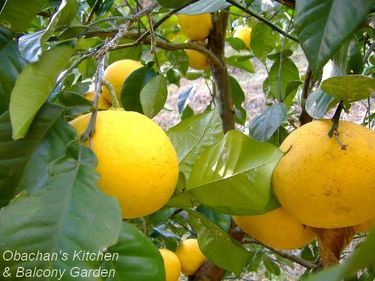
 Pound Cake with Candied Buntan Citrus Peels Ever since I started working at the supermarket, I have been craving sweets, especially cakes. After my work from dawn to lunchtime, I come back to my apartment and see bright afternoon sunshine coming through the lace curtain. Yes, it's my favorite time of the day. Soon it became my everyday routine to enjoy, after quick lunch, home-made sweets with hot black tea with milk. It is so cozy to watch the steam coming up from the tea cup. Nice buttery cake and warm tea heal me more than anything else. (And I guess my body is trying to develop a "thermal" fat layer to keep me warm when at work early in the morning. That must be the reason behind this craving for sweets.) :P  BTW, the candied citrus peels in this pound cake were made from buntan citrus from dad's orchard, and as you might have guessed, it was my mom who made them. Buntans look pretty similar to grapefruits, but they are less juicy than grapefruits and taste sweeter. The rind is much more bitter than that of regular oranges, but after the bitterness is largely removed by repeated boiling and soaking in water, buntan rind can make good candied peels with the remaining bitterness balancing out the sweetness of granulated sugar. Yes, I admit it. There's nothing wrong or outrageous about making candied buntan peels. BTW, the candied citrus peels in this pound cake were made from buntan citrus from dad's orchard, and as you might have guessed, it was my mom who made them. Buntans look pretty similar to grapefruits, but they are less juicy than grapefruits and taste sweeter. The rind is much more bitter than that of regular oranges, but after the bitterness is largely removed by repeated boiling and soaking in water, buntan rind can make good candied peels with the remaining bitterness balancing out the sweetness of granulated sugar. Yes, I admit it. There's nothing wrong or outrageous about making candied buntan peels.The problem is that making them has become my mom's major winter project in the past couple of years. (Her mom's summer project is making that bright-colored shiso drink. Remember?) And when she does it, she does it all the way. In summer, the two fridges at my parents' house are filled with plastic bottles with bright reddish-pink drinks, and in winter, me, my sister and mom's tea ceremony students receive her home-made candied citrus rinds in big ziploc bags more than once...  Mom's Candied Buntan Peels Mom says that she and her students munch on them as they chat after their weekly tea ceremony lessons and they all love them. (Of course. How could the students say anything bad about something their teacher made?) And I heard that my sis once baked bread with them. Here I am with this pound cake, gradually developing a fat layer underneath my skin. Hahaha ...  Categories: Sweets |
Tuesday, February 26, 2008
The Supermarket Chronicles - Part 1 -
Yes, I’ve survived another week at my new workplace, a small supermarket, and yesterday was the first payday. Of course the pay was very small because I started working there in the middle of this month, but it made me so happy. If I don't get fired for some reason, from next month on I’ll be able to pay all the bills, buy groceries and still have a little money left in my bank account. Yeah, mediocrity. I know. But in this country, if you are a single, middle-aged woman living in a rural town, even such a mediocre success can be hard to achieve sometimes. I mean it. The supermarket is only about 5 minutes by bicycle, which is very nice especially on rainy days in winter. Usually I meet my co-worker -- my mentor-- in the dressing room. Then we go downstairs to the small kitchen in the fish section of the supermarket, where our boss (who is the owner of the supermarket) and one elder guy are already filleting fish. There my mentor and I share some morning chores, including washing a fish scrap bucket in an outdoor sink using water and a scrubber. Yes, outdoor. Rain or shine. Or even snow. (Actually it snowed on my second day there.) Now you know why I need “high-tech” underwear? ;) After that, my mentor and I start packing the fillets and sashimi (sliced raw fish) the two guys prepare one after another. There’s an automatic wrapping machine there, and we punch in different code numbers to wrap up the seafood in Styrofoam trays with plastic food wrap and put proper stickers on them. Now, I don’t know if this is the same in other countries, but here in So there ARE challenges, but I guess I’m enjoying my work there. Maybe it has a lot to do with the fact that I was born and raised in a small fishing village until I was 12 years old. In my childhood, I often went to the local fishing port, and sometimes accompanied dad when he went fishing. The fishy smell or grotesque-looking fish scraps I smell/see at my work now are, of course, not very tempting, but those make me feel somewhat nostalgic rather than totally disgusted. That’s probably why I’m feeling better than the time when I was working at the bento shop. BTW, the photo is the horse mackerel that I filleted in my kitchen. I just wanted to post a seafood-related photo with this story. And I might change the title of this post soon. (I'm a bit tired of "******* chronicles.") … To be cont’d … Categories: Supermarket |

Friday, February 22, 2008
SPAM Chao Fan
 SPAM Chao Fan (Fried Rice) My lunch today. SPAM, egg, onion, green onion and rice. Can't go wrong. ;) Categories: Asian-inspired |
Monday, February 18, 2008
Cinnamon Rolls to Celebrate My Survival
 Cinnamon Rolls Today was my first day off at the new daytime job, and I was determined to bake something to celebrate my survival. Yes, survival. You know, I have never been an early bird (except for the times when I had to get up early for certain reasons), so getting up at 5:50 am every morning for 6 days in a row -- in the middle of winter -- was certainly a challenge for me.  I forgot to set the alarm off last night, so I woke up at 5:50 am this morning as usual. But it was nice to stay in bed, feeling happy about not having to rush to work. Happily dozing off once in a while, I thought about what to bake today, and finally decided to go for cinnamon rolls.  Sorry, those who gave me wonderful cinnamon roll recipes about a year ago when I gave it a try for the first time. Today, I thought about trying one of yours, but I just didn’t feel like doing the conversion! So I took an easy way out, which means, I, again, relied on ”allrecipes.” (The site takes care of U.S.-metric conversion as well as changing the serving size.) This is the recipe I picked this time, but I baked mine in a square pan instead of muffin cups.  Because I didn’t have enough all-purpose flour, I mixed in bread flour and even cake flour to make the dough. Also, I chickened out about the amount of margarine (actually I substituted it with butter) and used a lot less of it for the filling. So my cinnamon rolls didn’t turn out as gooey and moist as I had wanted, but still, I think I made a big progress. ;)  Categories: Sweets |
Thursday, February 14, 2008
Happy Valentine's Day!
Categories: Sweets |


Saturday, February 09, 2008
Daikon Simmered with Hotate
 Daikon Simmered with Canned Hotate (Scallops) with Blanched Komatsuna on the side When making a simmered dish with daikon radish, it is generally recommended to pre-boil it with a little amount of raw rice or in rice rinsing water until a toothpick can be inserted easily. It is a well-known tip here in Japan, but most of us do not know the scientific reason behind it (or if there is one at all). So, having been triggered by a question from someone who read my buri-daikon post, I did a bit of net research. Let me share the result with you. In a nutshell, the pre-boiling process mentioned above is supposed to remove the slight bitterness or harshness of daikon and make simmered daikon soft and tasty. They say that adding rice, or using rice rinsing water for this process means boiling daikon in a colloid solution, and the bitter substance contained in daikon will be adsorbed onto the colloidal particles during this process. If a colloid solution is the key, then can’t we just add regular wheat flour or corn/potato starch in place of raw rice? Well, some Japanese websites say that a little amount of wheat flour will do, but I found one person saying that it’s not a good idea because wheat flour contains some protein (but didn’t really mention how that protein negatively affects this process). And more than three people wrote that if used potato starch, the simmering water will turn into glue, which I totally agree with. (I mean, if used too much of it.)  On the other hand, some people do say that using raw rice or rice rinsing water is not necessary; pre-boiling in regular water is just fine. Or some even say that pre-boiling is not necessary at all because these days daikon radishes do not have such strong bitterness. Confusing, isn’t it? What I do -- as a sort of compromise solution-- is: do pre-boiling for simmered daikon dishes with light seasoning, and skip it for those with heavy seasoning. To me the best example for the former is furofuki-daikon, and the latter is oden or buta-bara daikon (daikon simmered with pork ribs). I put buri-daikon (daikon simmered with yellowtail) in the former category, because the fish has the risk of giving an unwanted fishy flavor to the dish, so I don’t want any additional unwanted flavoring from the daikon. Personally, I believe that this pre-boiling trick makes a big difference when you want to enjoy the delicate taste of daikon itself with light seasoning.  Then I have no idea if there is a way to avoid certain bitter parts in a daikon or tell bitter daikon from non-bitter ones. Harvest season or fertilizers used may make some daikon more bitter than others, but how can you check out such information when buying one at the store? So all I can say is, "To choose good daikon, choose fresh ones. And if worried about bitterness in simmered daikon dishes, don't skip the pre-boiling." That's about it. Sorry.  As for the softening effect, some say that an enzyme contained in rice bran makes daikon soft, though I couldn’t find any site clearly mentioning the name of the enzyme. But in my experience, daikon did soften quicker when a little amount of rice or rice-rinsing water was used for pre-boiling. So, to me this pre-boiling technique is not a mere old-wives tale, but some of the seemingly scientific explanations seem pretty wishy-washy. That’s the way I see it. And I don’t really need to find out the ultimate truth of daikon boiling anyway. What’s more important for me is the feeling of warmth and happiness that a tasty winter dish brings to me…  ... like THIS! :D ** Just in case: After chopped daikon are "pre-boiled"with raw rice or in rice rinsing water, they need to be drained, rinsed with running water and then cooked in water and seasonings. You don't want to use the colloid solution from the pre-boiling for cooking and seasoning the daikon, of course. Categories: Japanese |
Wednesday, February 06, 2008
Renkon Hambaagu (Lotus Root Cakes)
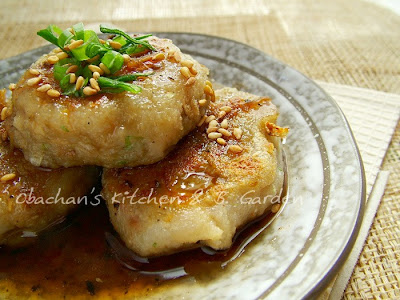 Renkon Hambaagu (Lotus Root Cakes) * I think lotus root "cake" sounds better than "steak" so I changed the title and the caption. Thanks Ilane :) My colleague at the language school bought a macrobiotic cookbook recently. She let me read it while at work, and this recipe caught my attention. The dish is called renkon hambaagu. Renkon means lotus root in Japanese, and hambaagu is the Japanese name for hamburger steak or Salisbury steak. Basically, what this is is fried lotus root pate (if I can call this a 'vegetable pate') with soy-based sweet-n-salty sauce. Grated lotus root is the main ingredient. And the neat trick is that crushed yaki-fu is used in place of bread crumbs.  So what is yaki-fu? It is dry baked wheat gluten, according to wikipedia. I usually use it for soup or simmered dishes, but never thought about using it for something else. And crushing it to use it as a substitute for bread crumbs was a totally new idea to me. Yes, I like this idea very much now.  Renkon (Lotus Root) and Mochi-fu The baked wheat gluten I used this time was mochi-fu, a chewy type of yaki-fu. Maybe that was why my renkon hambaagu turned out pretty soft and elastic. I liked that. And the roasted sesame seeds I added to the pate (though it was not mentioned in the original recipe) was a good accent.  The ingredients of my sauce were soy sauce, water, mirin, minced ginger and a little sesame oil. The original recipe called for mushrooms, which I omitted this time. I will give it a try next time. Another thing I really want to try next time is adding chopped shrimp to the pate. I think it would add a nice flavor and go well with the sauce, too. * Original recipe from: "Macrobiotic Hajimemashita" P.S. I got a daytime job today. FINALLY! So starting next Tuesday, I'll be working at a small supermarket in the neighborhood. Wish me luck. :) Categories: Western-inspired, Japanese |
Sunday, February 03, 2008
Home-made Taco Shells and Fresh Tomato Salsa
 Home-made Salsa. (Next time I'll definitely go for a store-bought one...) I crave Mexican food once in a while, and for some reason, it's usually on Saturday. (The post from 2005 was posted on Sunday, but the dinner was made on the night before.) I wonder why. Maybe it has something to do with the way I spent many Saturday nights in the U.S. more than 10 years ago? You know, Taco hell, coors light and Saturday Night Live?? Now I am an obachan and my Saturday nights are a lot less exciting, but I still feel like Mexican food on some Saturday nights. And yesterday at the import food shop at the mall, I found something very tempting.  GABAN "Taco Shell Mix" Yes. The instruction on the package said "Just add vegetable oil and water." Sounds easy. And I can actually make hard taco shells in my kitchen? Wow! I have to give it a try! 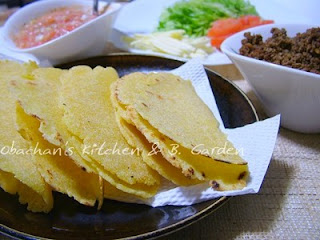 Take a look at my very first home-made hard taco shells! Unfortunately, they didn't turn out very crispy. But it was fun to make them, though I broke one of the shells when folding it. The biggest mistake was that I forgot to buy salsa. I tried to make something similar with the ingredients I could find in my kitchen, but it was undoubtedly a bad idea. Yes, what I made tasted sour and spicy. But it just didn't taste like salsa. Categories: Other areas |
Subscribe to:
Posts (Atom)