


 Kimchi Udon Unbelievable! Just about a week ago, we had a summer-like sunny day. Then today, I was almost frozen to death on my way back from work at night. I HAD to have a warm, spicy soup dish, and this is what I had for dinner to bring me back to life. Gosh, it's already late November... Time to start thinking about Christmas fruitcake! :D
|
Showing posts with label Noodles. Show all posts
Showing posts with label Noodles. Show all posts
Tuesday, November 18, 2008
Because It Was So Cold...

Thursday, March 06, 2008
Udon Dashi (Tsuyu)
 Tsukimi Udon (Udon noodles with an egg on top) If you like Japanese food, or have made Japanese dishes yourself, you probably know or at least heard of dashi broth. The word dashi usually means unseasoned stock made by boiling things like kelp, bonito flakes, dried baby fish or mushrooms. Sometimes it can mean seasoned broth for noodle dishes, as in the title of this post, but maybe the word tsuyu is more commonly used in that case. As some of you may know, in Japan, the region covering Tokyo (capital) and several surrounding prefectures is called Kanto, and that covering Osaka and neighboring prefectures is called Kansai. And broths of udon noodle dishes in Kanto and those in Kansai are distinctively different. The Kanto version and Kansai version have been considered as two major types of udon broths in Japan, and (I suppose) udon broths in other regions have been roughly categorized in either of those two. The difference? Well, take a look at this website of a popular Japanese TV show. What’s in those bottles are udon broths collected from different regions in Japan. (A staff rode a west-bound bullet train from Tokyo and ate udon to collect broth samples at the stalls on the platform at the major stops. :D) The bottle at the far right is udon broth from Tokyo, and it goes west as it goes to the left. You see the color difference? It is said that in Kanto, they use mainly bonito flakes to make the dashi stock, and then season it with generous amount of regular soy sauce which makes the broth dark brown. On the other hand, in Kansai, more kelp and even dried baby fish are used to make stock in addition to bonito flakes, and often their bonito flakes are not the thinly shaved ones usually used for Japanese traditional clear soup.  The above photo is the thinly shaved bonito flakes usually used for traditional clear soup. But I heard that they use much thicker bonito flakes for Kansai udon broth and even mix flakes of a few different kinds of dried bonitos. And the most important seasoning ingredient is LIGHT soy sauce. Yes, it's got to be light soy sauce. Now, have you noticed that I kept writing “it is said,” “they say” and “I heard” in above passages? Here’s my confession: I had never made udon broth from scratch until this time -- I always used instant udon dashi mix. And my mom did so, too. Even though I have lived in Kansai region for apx. 20 years, I never knew exactly what they used for making udon dashi there. Thus, what's in the photo below are the udon broth ingredients I bought this time, based on the knowledge I have gained from the Internet. :P  See how thick the bonito flakes are? Well, the broth I made with these ingredients and the seasonings in the recipe below tasted pretty close to the udon broth I had in Kansai and here in Kochi, so I think I’m on the right track. Now, thanks for your patience. Finally, here's the recipe I came up with by conbining a couple of Kansai udon broth recipes on the net. Udon dashi (tsuyu) recipe, Kansai type * For making the stock (for 2 to 3 servings?) 1700 mL water 20 g dried baby fish 30 g dried kelp 30 g bonito flakes (thick type, mixture of different kinds, if available)  Put 1700 mL water, dried kelp and dried baby fish in the pot. Leave for more than 30 minutes. (Remove the heads and guts of the dried fish beforehand if you want the broth milder.) Heat over low heat for 10 to 15 minutes and take out the kelp before it starts boiling. (DO NOT boil the kelp, or the slimy stuff from the kelp will really ruin the flavor of the broth!) Turn the heat to high and add bonito flakes and boil for about 5 minutes, if used thick bonito flakes (and maybe 3 minutes if used thin bonito flakes). Drain. * The photo shows how I drain it. ---> Put 1700 mL water, dried kelp and dried baby fish in the pot. Leave for more than 30 minutes. (Remove the heads and guts of the dried fish beforehand if you want the broth milder.) Heat over low heat for 10 to 15 minutes and take out the kelp before it starts boiling. (DO NOT boil the kelp, or the slimy stuff from the kelp will really ruin the flavor of the broth!) Turn the heat to high and add bonito flakes and boil for about 5 minutes, if used thick bonito flakes (and maybe 3 minutes if used thin bonito flakes). Drain. * The photo shows how I drain it. --->* For making udon dashi broth (for 2 to 3 servings?) 1000 mL dashi stock 1 teasp. salt 1+1/2 Tbsp. light soy sauce 1+1/2 Tbsp. mirin Heat dashi stock, add seasonings. Add boiled udon noodles and cook for a couple of minutes. Serve with your favorite toppings such as minced green onions, wakame kelp, slices of kamaboko or sumaki (steamed fish cake products), tempura, tenkasu (tempura batter flakes) and shichimi pepper. * If you are interested in making udon noodles yourself, see this website. Now, as some of you readers have brought up in the comments, there is another place that you cannot miss when talking about udon culture in Japan. It is Kagawa prefecture known as Sanuki in olden days, and their thick-n-chewy Sanuki udon noodles are made by putting the udon dough in plastic bags and stepping on it to knead it with heels. And the key ingredient of their udon broth are dried baby sardines called iriko and their local light soy sauce. Those facts were already known (at least, among some people) in other areas in Japan, too, but what really made Sanuki udon -- as well as the udon culture in Kagawa prefecture -- popular throughout the country were probably this book, "Osorubeki Sanuki Udon" and this recent(?) movie called “UDON.” Thanks to the media attention, recently some people even dare to add a third category, "Sanuki udon broth" to the big two, Kanto and Kansai versions, and say that Sanuki version is a bit saltier and lighter-colored than Kansai broth.  Unfortunately I have never had a chance to eat udon in Kagawa, but rumor has it that there are more udon noodle shops than traffic lights over there, or Kagawa natives only eat udon for lunch, or local people bring their own udon bowls and chopsticks to local udon noodle manufacturers (small, mom-and-pop type places) and enjoy old-fashioned good udon dishes which are not available at regular restaurants, etc. etc. And the place I’m interested in the most is this hilarious udon school where they teach you to dance on the udon dough to knead it. I’m not kidding. Believe me. Lucas of Nihon no Ryori actually gave it a try there. And here is another post about the udon school. Looks like a lot of fun, right? But even before they wrote about it, the taste of Sanuki udon must have been already introduced outside Japan, because someone picked it as one of “The Top 50 things every foodie should do” in 2005. How flattering. ;) Categories: Japanese |
Saturday, December 08, 2007
Experimenting with Yuzu Kosho - 1- Chicken and Lettuce Pasta
 Chicken and Lettuce Pasta with Yuzu kosho So today I tried out one of the yuzu kosho pasta recipes that I found on the net. Well, to be more precise, I combined two different recipes ('chicken and lettuce pasta with yuzu kosho' and 'Tuna cream yuzu kosho pasta') and added my own twist, too. Let me call this "chicken and lettuce cream pasta with yuzu kosho." Long name, ha? The ingredients were: chicken, lettuce, spaghetti, garlic, olive oil, heavy cream, salt, pepper and yuzu kosho.  The dish turned out better than I had expected. When I took the first bite of the pasta, I thought it was very light-tasting... almost close to being bland, even with the refreshing aroma of yuzu. (Maybe I added a little too much pasta cooking water. See how runny the sauce is in the photo?) But a pleasant kick of green chilli followed right after, and it made me want another bite, and one more... until the dish was finally empty! :D And it went so well with sparkling rose wine. Categories: Western-inspired, Japanese |
Saturday, November 24, 2007
Shishito Pasta
 Shishito and Shirasu Pasta  My colleague gave me some shishito yesterday and I tried out a "shishito and shirasu (dried baby sardine) pasta" recipe. My colleague gave me some shishito yesterday and I tried out a "shishito and shirasu (dried baby sardine) pasta" recipe.Very simple seasoning -- garlic, olive oil, red pepper and salt -- but surprisingly tasty. I enjoyed it with yuzu chu-hai and 'cheese on baguette' (?). Mmmm.... should I categorize this under "Japanese" or "Western-inspired?"  Categories: Western-inspired, Japanese |
Wednesday, September 12, 2007
Before the Summer Is Over...
 Tomato and Zucchini Pasta Did someone say, "This summer I’m interested in expanding my repertoire of Italian dishes?" Do you remember reading something like that? Oh well, that person must have thought that she had to keep her word and make another Italian dish before the end of summer. Hahaha... Honestly, it's getting cooler here -- FINALLY! I don't need to have the air conditioner on at night any more. And a couple of red dragonflies I saw today told me that the summer is almost gone, which pressured me to cook (and post) at least one more Italian dish before it is officially autumn.  So, this was a quick, easy and tasty lunch I whipped up today. I got this idea from someone's blog (Japanese) several days ago. Actually she added things like balsamic vinegar and anchovy, but what I made today was much closer to this English recipe, if you're interested. It was still very good without those fancy stuff, I would say. So, this was a quick, easy and tasty lunch I whipped up today. I got this idea from someone's blog (Japanese) several days ago. Actually she added things like balsamic vinegar and anchovy, but what I made today was much closer to this English recipe, if you're interested. It was still very good without those fancy stuff, I would say.BTW, I had good luck with my basil this year. The leaves did not grow big like previous years, but the plants were healthier and absolutely no insect problem! :D Categories: Western-inspired |
Thursday, March 29, 2007
Spaghetti Meatballs
 Spaghetti Meatballs It was this post by ting-aling that triggered my craving for this dish. Again, it happened pretty late at night. Maybe I should quit bloghopping at night... but when else? Categories: Western-inspired |
Sunday, January 07, 2007
Instead of Nanakusa-gayu...
 Nabeyaki Udon (cooked in a clay pot) Yep, I thought about having Nanakusa-gayu today. Having so much osechi and sake yesterday, warm and comforting rice porridge with healthy herbs seemed like a very good idea. But when I picked up one of the packages of fresh "Nanakusa (seven-herbs)" at a supermarket, my inner voice said, “Hey, with Nanakusa-gayu, you can’t use up the leftovers from yesterday.” That’s right. So this is what I had today instead: Nabeyaki udon with lots of toppings. Most of the toppings look familiar, right? What’s on top right is a soggy kakiage made with mitsuba, burdock and dried shrimp. And under the udon noodles, plenty of carrot and daikon strips are hiding. It’s so cold outside, but I’m in a warm room, eating this nabeyaki udon at kotatsu, watching TV. Totally relaxed and contented… Mmmm…Happy.... Hope everyone on the face of the earth is happy and contented like me on a cold winter night like this. :) Categories: Japanese |
Thursday, December 21, 2006
Something Warm for Late Night Supper
 Despite the obvious signs of global warming, it’s finally getting cold here in Kochi. My late night supper tonight was a bowl of instant ramen noodles in very thick soup and with lots of vegetables. Mmmm… warm... :) Here in Japan, we are experiencing the worst outbreak of norovirus now. I've been avoiding buying packed bento recently. Categories: Asian-inspired |
Tuesday, August 15, 2006
I Needed Something Refreshing for Lunch Today - Somen Noodles -
 Somen Noodles Well, I was quite busy for the past couple of days, shooting photos at the dance festival and posting them to another blog of mine. To tell you the truth, on August 10th and 11th, which were the main festival days, I didn’t eat decent supper because I kept moving from one dance venue to another all afternoon and evening, then went straight to work at night. On those two days, my supper was either one pack of takoyaki (octopus balls) or two sticks of hashimaki (Japanese thin vegetable pancakes wrapped around chopsticks). And on the 13th and 14th, I spent all my time in front of my laptop except when I was at work, editing my photos and changing the template of my scribble blog until my brain boiled. To prevent myself from starvation, I made a big pot of Japanese-style curry, and it was my lunch and dinner for those two days! If you are interested, the photos are here, though I haven't finished the write-up yet. Please do enlarge the close-ups of the female dancers. It took me a while to upload them in that size and with that quality, without making the post crazily heavy, but it was worth the effort, I guess. ;) Anyway, today I gave my brain and my stomach a break with cool, soothing summer dish for lunch.  Somen is really easy to make if you have store-bought somen soup, but this time I used the soup I had made from scratch about five days ago and stored in the fridge. Many Japanese noodle soup recipes tell you to use kombu kelp and bonito flakes to make dashi stock, but I used dried shiitake mushrooms in addition. To me the shiitake mushroom flavor is “the must” for somen noodle soup. Somen is really easy to make if you have store-bought somen soup, but this time I used the soup I had made from scratch about five days ago and stored in the fridge. Many Japanese noodle soup recipes tell you to use kombu kelp and bonito flakes to make dashi stock, but I used dried shiitake mushrooms in addition. To me the shiitake mushroom flavor is “the must” for somen noodle soup.Usually I serve somen noodles in soup, but today I wanted to do it the way they do in those TV commercials, so I served a little thicker soup in another bowl to dip noodles in. But I poured the soup over the noodles at the end, because I figured that it was the best way to enjoy the toppings with the soup. :P 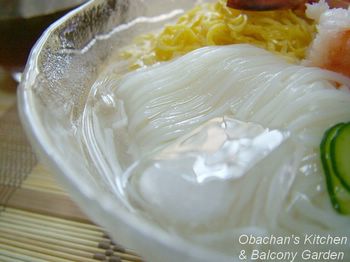 Looks pretty refreshing? Categories: Japanese |
Monday, July 03, 2006
Kimchi Reimen
 Kimchi Reimen It’s already reimen season in Japan. I remember that it was this time of the year when I posted about the cold, refreshing noodle dish last year. Though it is not a traditional Japanese dish, reimen is a staple of summer over here these days, and I’m very grateful for the person who invented this dish. Because it was so incredibly hot and humid, I made reimen for lunch today. I used the same reimen kit as in this post, which included noodles, ready-made soup and mustard in a package. The toppings were a little different this time, though. Yes, I prepared the egg differently, and added kimchi for a spicy kick. Yum! :D Categories: Japanese, Asian-inspired |
Wednesday, May 17, 2006
Sticky & Slimy...
 Mekabu Huwa-Toro Udon There is a franchise udon place called“Hanamaru udon” near the office I work at in the daytime. It is a self-service place which is very convenient for someone who wants to have quick lunch alone, like me. They have a good variety of non-expensive udon and sides, and in the typical fast-food setting, it is usually easy to find a vacant counter seat. Yes, that is a cafeteria-type self-service place where you take a tray first and pick the topping(s) and side(s) you want from the shelves, then order the kind of udon you like, which will be prepared within a minute or so, and finally move to the casher and pay. This sticky & slimy udon is one of their recent entries. They have several versions of this huwa-toro series, including: natto, mekabu and beef, for each of which you can have a choice of either cold or warm soup. The one in the above photo is the mekabu version. OK. Let’s see what the name of this udon, “mekabu huwa-toro udon” tells us. Mekabu is the slimy green stuff next to the egg (right) and it is sporophyll of wakame kelp (Undaria pinnatifida). It is supposed to be rich in fucoidan which is said to have several health benefits. Fuwa (fluffy?) probably came from the texture of the grated yam, the white stuff next to the egg (left). Yam is rich in mucin which is said to enhance the digestion and absorption of protein, and protect the stomach wall, thus lowering the risk of gastric ulcer. Toro (slimy?) applies to all of the mekabu, yam and okura. Here in Japan they say slimy foods are good for health, and the combination of fucoidan and mucin does sound healthy to me. The only problem with this dish was that after you finish udon noodles, most of the healthy ingredients were left in the bowl with the soup. But if I’m not mistaken, they started offering an optional free (?? I’m not 100% sure about this point) bowl of rice with this dish so that you can pour the slimy soup mixture over the rice to make a very healthy and tasty donburi. I might give the donburi a try next time. BTW, hanamaru is a rating given to something that is well-done in Japan. Oh, that reminds me… In Japan, in most school settings, teachers give circles to the correct answers and checkmarks to wrong ones on your written exams. (So you can imagine how shocked I was to see so many checkmarks on my first written exam in the U.S.) In my childhood, kindergarten and elementary school teachers gave hanamaru (flower circle) when they thought a kid did a very good job. I wonder if they still do that these days… Categories: Japanese |
Saturday, October 29, 2005
Salmon & Tomato Spaghetti
|

Thursday, July 14, 2005
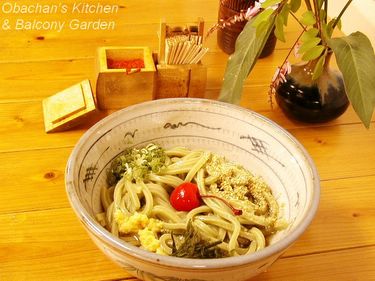
Kawa-Udon
|
Wednesday, July 13, 2005
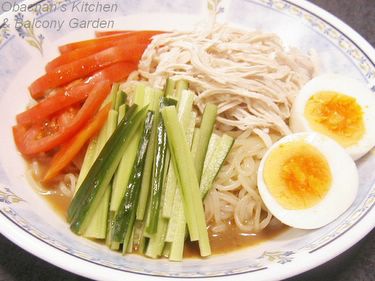
Reimen, Not Ramen
|
Saturday, February 26, 2005
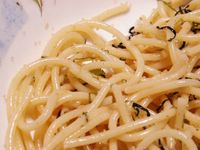
Izakaya Menu -1- Mentaiko Spaghetti
OK, for those (including foodpocket) who are interested in what kind of food we make at the Izakaya where I work, here’s one thing we serve there: Mentaiko Spaghetti. |


Thursday, December 30, 2004
Toshikoshi-Soba
|

Tuesday, November 09, 2004
Something Quick & Hot - Nabeyaki Udon -
|
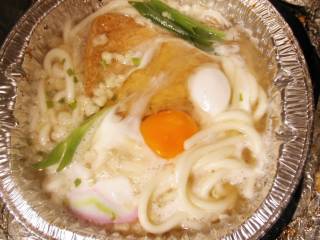
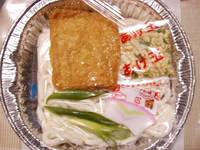 What I got today is --- busy mom’s helper and lazy obachan’s best friend --- an instant Nabeyaki-udon package. Instead of a clay pot, you can use this aluminum container to heat the udon. Everything you need is packed inside: udon noodles, a slice of kamaboko (steamed fish paste), negi, agetama (deep-fried crispy batter flakes) and aburage (deep-fried tofu ). There’s a plastic bag full of soup underneath the noodles. All you have to do is just take everything out of the plastic bag, put in the aluminum container, and heat on the stovetop. E a s y :)
Saturday, October 30, 2004
Supposed to Be Appetizingly Green, But...
|


Subscribe to:
Posts (Atom)