Showing posts with label Claypot dish. Show all posts

Sunday, November 04, 2007

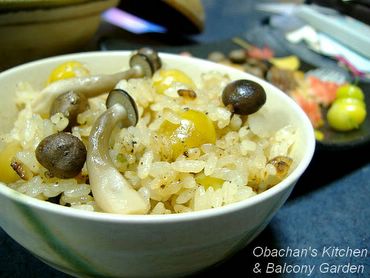
Tai Meshi


Tai Meshi (Japanese pilaf with sea bream??) Cooked in Donabe

I'm not sure if "pilaf" is a proper translation for Japanese "takikomi gohan." When making pilaf, do you always need to saute raw rice (with butter) before cooking it in broth? Japanese takikomi gohan does not require sauteing rice, so maybe it shouldn't be called "pilaf." But I guess, from this translation, you can get some idea of what takikomi gohan is like, right? ;)

Here in Japan, tai (sea bream) is an expensive fish which is used for formal celebrations including wedding, baby's "first-feeding ceremony" etc. and also when someone achieved a great success. Thus, tai meshi also sounds like an expensive dish, and it actually was, I think, in the past. But these days young Japanese wives make the dish more casually and economically, making a good use of store-bought sea bream sashimi. Yes, those raw fish slices that come in plastic containers. Usually you see only 7 or 8 thin slices in one pack, but the good thing about tai meshi is that you don't need a whole lot of fish -- the fish is supposed to be mixed into rice anyway... like this.


I usually grill the sea bream beforehand, as recommended in many tai meshi recipes. I guess that makes the dish less fishy and more fragrant. The thinly sliced dark-green stuff in the top photo is kombu kelp from making dashi stock. Of course, it was my own crazy idea, but I always don't know what to do with the kelp after making dashi stock, so I thought adding it to this tai meshi could be a good idea -- It might even add extra umami. ;)


Categories:

Friday, September 22, 2006

Asari Takikomi Gohan
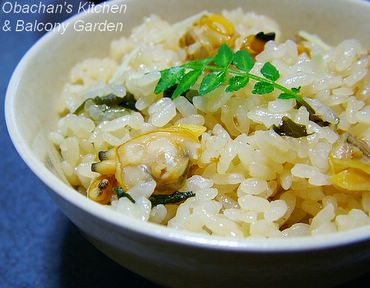

Asari no Takikomi Gohan (Japanese Pilaf with Short-necked Clams)

When it starts getting cooler and more and more autumn fruits start occupying the shelves at local grocers and supermarkets, I feel this strong urge to make takikomi gohan (Japanese pilaf) with my donabe (clay pot). Today I went for asari (short-necked clam) takikomi gohan, which was actually part of the course meal at our kaiseki place last month.

When it comes to takikomi gohan, there is one rule that I always follow: I never make takikomi gohan without sake and mirin. Well, actually I might go for it if I had either one of them, but if I run out of both, I never make takikomi gohan. For me these two ingredients make a lot of difference. As I probably wrote somewhere before (did I? I don’t remember exactly…) alcohol and amino acids they contain contribute in adding extra flavors as well as helping the food absorb flavors of the seasonings.

And what’s more, mirin prevents food from being mushy while being cooked. It is said that it prevents certain binding substance between cells from melting when heated. So, for me, mirin is a crucial ingredient for this kind of dish because I cannot stand mushy rice, especially mushy takikomi gohan. (I heard that professional Japanese chefs often add a little mirin or salad oil when they cook rice for making donburi, because mushy rice is a big no-no for that type of dish.)

For this takikomi gohan, I used asari and wakame kelp. The topping -- sansho (Japanese pepper) leaves and minced ginger -- were supposed to reduce the fishiness and bring out the flavor of asari clams. I made nameko mushroom miso soup to accompany this rice dish.

Oh, there’s one more thing: To make this takikomi gohan, I used the new rice harvested just recently. Actually, here in Kochi, it’s not a big deal to be able to eat new rice in September, because it is usually available in late August. Here people plant rice earlier so that they can harvest it before the typhoon season comes. One thing you have to be careful about cooking new rice is using a little less amount of water. New rice contains more water than older rice, so adjustment is necessary. Well, I’m talking about the sticky short-grain rice we eat here in Japan, but I wonder if it is the same with long-grain rice.


Categories:

Thursday, December 29, 2005

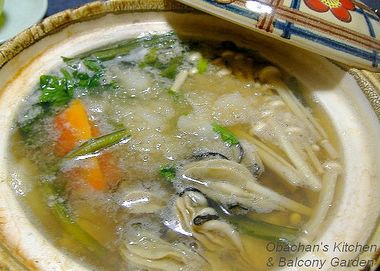
Kaki Mizore Nabe


Kaki Mizore Nabe

I’m no dietitian so I don’t know if this makes sense from a nutritional standpoint, but I crave for things like miso soup, shellfish soup and vinegared dish after I experienced an overdose of sugar, fat and alcohol. Well, I already finished my ritual of consuming miso soup, and here comes the shellfish. My supper last night was
kaki mizore nabe. Kaki means oysters and here’s the explanation of what mizore nabe is. Yeah, I didn’t have enough daikon to make this one look like a real mizore nabe, but oh well, at least I tried. 
The ingredients this time were oysters, shungiku (garland chrysanthemum), enoki mushrooms and carrot. Everything was so tasty with my favorite yuzu-pon.

And this is the ritual that follows eating nabe dish…

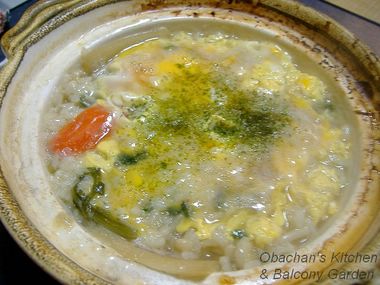
Rice porridge made with the leftover soup of kaki mizore nabe

Some people might feel strange about using grated-daikon mixed soup for porridge, but it didn’t taste funny or anything at all. It was just so comforting. :)

Monday, December 05, 2005

Special Donabe Dinner!


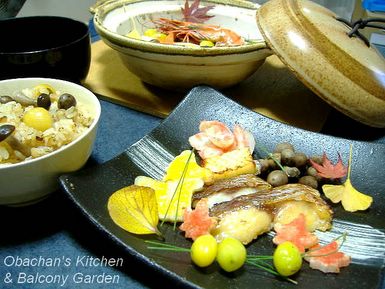
Special Donabe Dinner, Autumn 2005

It’s a good season to enjoy donabe (Japanese clay pot) dishes. Last Thursday was my day off, and I tried something I’d always wanted to make using donabe. Yes, takikomi gohan ( pilaf-like rice dish) was one of them, but what I really wanted to try this time was “horoku-yaki (food roasted in horoku).”

Horoku is a traditional unglazed cookware used for roasting nuts/sesame seeds or steam-roasting food, and it comes in different shapes according to its usage. The one used for horoku-yaki usually consists of a shallow unglazed flat bottom and a dome-shaped lid like the one in this photo.

Though I don’t have a horoku like that, I do have a donabe, and a few websites (incl. the one linked above) said that horoku can be considered as a kind of donabe, so theoretically you can use a donabe for making horoku-yaki. OK, then, why not? ; ) Fortunately at our izakaya, they have a few horoku-lids they don’t use any more, and I borrowed one of them on Wednesday. I know I could have used my donabe-lid, but I just wanted it to look more horoku-like. To accompany the main dish, I decided to make takikomi gohan, clear soup and fukiyose, oh, and dessert, too. (I once thought about trying an autumn version of quasi-kaiseki, but I just didn’t have enough energy, so this is a simplified version. ;P)

On the day before..:
Rumor has it that there was a middle-aged woman picking fallen leaves in Josei Koen (park) that day. The same woman was witnessed picking up a small pine branch on the ground near Kochi castle that night. I wonder who that was. ;)

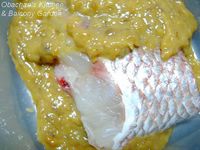
I made yuzu moromi miso using the moromi miso that my colleague gave me last September. Then I coated two slices of raw sea bream fillet with the yuzu-miso and kept them in the fridge overnight. One slice was set aside (not coated with miso) for the clear soup.

On Thursday…:
Now my first adventure of the day was trying out a unique method of cracking ginkgo nuts that I read on so many Japanese websites recently. It is putting the nuts and a pinch of salt in a paper envelope, folding the top part three or four times very tightly so that it won’t open up when the envelope swells, and microwaving it for 1 to 1.5 minutes (or longer.) They say that you should wait until you hear popping sound four or five times, and some might burst into pieces, but the success rate is usually satisfactory. Well, if they say so, I've got to give it a try myself.

The popping sound was so big that it almost scared me to death! In my case, the success rate wasn’t so good…out of apx. 15 ginkgo nuts, 3 or 4 cracked properly and 3 burst into pieces. The rest? I used a plier to crack and removed the shell, crushing a couple of nuts. :(
* Some Japanese websites say that it is recommended to crack the shell a little (using a nut cracker, plier or hammer) before you put the nuts in the envelope.

Now, here's the menu of my special dinner :)

Entries:
- Mukago Takikomi Gohan (Pilaf-like rice cooked with air potatoes)
- Sea Bream Soup
- Fukiyose (Assorted bite-size foods)
- Horoku-Yaki (Food cooked in horoku)
- Dessert: Nerikiri


Mukago Takikomi Gohan


Mukago Takikomi Gohan (Pilaf-like rice cooked with air potatoes)

Mukago are small bulbs on wild yam vines, which I have tasted only once before. They do taste like potatoes with a slightest hint of bitterness. I used briefly blanched mukago, ginkgo nuts and shimeji mushrooms for my takikomi gohan.

I used this recipe (downsized to half, omitted salmon) and cooked the rice the same way as I cook chicken takikomi gohan, but maybe I should have cooked it shorter this time. The bottom was burned a little. But the taste was soooooooooooooo good! :)

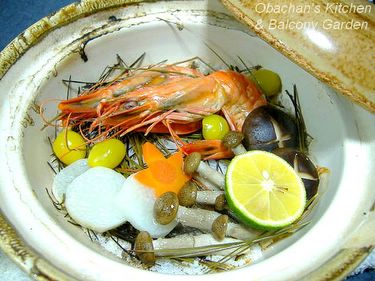
Horoku-Yaki


Horoku-yaki

Here's how to make a horoku-yaki. First, cover the bottom of donabe with coarse salt, then scatter pine needles all over. You might want to place a piece of washi (Japanese traditional paper) so that the ingredients wouldn’t touch the salt and pine needles directly. (Some online Japanese recipes recommended it while others didn’t). I didn’t do that this time because I wanted to know how salty the food would turn out without washi.
Though no recipe mentioned about this, I sprinkled a little sake over all the ingredients (prawns, ginkgo nuts, shiitake and shimeji mushrooms, carrot and sliced yam) and placed them directly on the pine needles. Then I put the lid on and heated the donabe on mid-low heat for….Sorry…I forgot to time it. Could have been less than ten minutes, maybe???

When I opened the lid…

Oh, the aroma!! The food inside was steam-baked with the effect of far-infrared ray from the clay pot. (Believe me. We Japanese are crazy about far-infrared ray effect.) See the dew on the shimeji mushrooms?

With a zest of sudachi, everything tasted WONDERFUL! I often hear the phrase, “It brings out the true flavor of ---“, and I think this cooking method really does it. I mean it. Prawns were oh so good, and I especially loved the yams! The coarse salt did not stick to the food almost at all, and I carefully scraped it off if it did. But if used finer salt, it might be necessary to use more pine needles or a washi paper.

As you can probably see, this was actually a little overdone. I left the donabe on heat even after hearing small crackling noise from the pine needles… Maybe I should have removed the pot from heat as soon as I heard the first crackling noise, or even earlier.

* I use this type of heating device, and I had no trouble making a horoku-yaki with my donabe this time. But it may not work the same way or could be even dangerous when a different type of heating device is used. I have no idea what it would be like if you tried donabe-cooking on an electric range like this, so please be warned.

Anyway, these were the main entries of my special donabe dinner, Autumn 2005.

(Doesn't this look like one of those photos on autumn package tour pamphlets by Japanese travel agencies?)

Friday, January 28, 2005

Sleet in a Claypot? - Mizore Nabe -


Mizore nabe

It was sooooooooo cold today. While I was riding my bicycle this afternoon, my mind was occupied with a fantasy of steaming hotpot dish…with tori dango (chicken meatballs). At first I was planning to have a regular nabe, but when I saw the leftover daikon at home, I decided to make it a “mizore-nabe.”

Mizore” means sleet, and mizore nabe is a nabe dish with grated daikon on top. Pretty healthy dish.

Ingredients

Recipe…..sorry, I didn’t measure anything. I just put Kombu (kelp) in water and heated it, added a little sake, soy sauce and mirin, then threw in the ingredients. My special chicken meatballs were lightly seasoned with salt, pepper, sake and soy sauce. I scooped the meat mixture with a spoon and dropped in boiling dashi.


When everyting was done, topped with grated daikon ( see the photo on top) and simmered some more. Oh, I browned the mochi (rice cakes…leftover again) in oven toaster beforehand.


Served with shichimi pepper and yuzu-ponzu.


Ahhhhh………. Hot and delicious...!!!


Tuesday, December 21, 2004

Takikomi Gohan in Donabe - Japanese Pilaf cooked in Claypot -
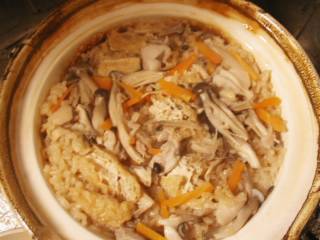

Tori (chicken) Takikomi Gohan (Japanese-style Plaf)


This post is now being modified.
Please wait until I post it again with better instruction and more information.

** Thank you for your patience. **


Thursday, December 16, 2004

Lazy Day


Pan-fried Chicken with Orange Sauce

Today was my complete day off. I felt kind of heavy (maybe because of the allergy medicine ?), so I decided to postpone my grocery shopping and stay in my apartment all day. It was easy to decide what to cook today because I knew the chicken and leftover orange half in the fridge needed to be used ASAP. My choice was pan-fried chicken with orange sauce --- pretty straightforward combination, don’t you think? I didn’t follow any recipe…I didn’t even google on the net for a recipe. All I used was salt, pepper, garlic, ginger, orange (slices and juice), butter and dried herbs, and it turned out OK.

Yesterday someone brought bunch of green vegetables (from her own vegetable garden, I guess) to our office to share. This was my share of the vegs.

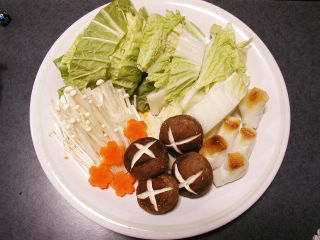
My supper tonight was very healthy miso-soup based nabe with lots of greens, pork and atsuage (deep-fried tofu.)


Yeah, I admit that I pretty much goofed off today. The only productive thing I did was taking off almost all the leaves/flowers/flower buds from my blueberry. I had to do so because my dear blueberry is now affected by leaf rust :( Hope it'll survive this winter and bloom again in the coming spring.

Well, so, I got rested, had lots of vegetables, and I’m going to bed early tonight. I should be full of energy and feel like a brand-new person tomorrow morning (hopefully.)

Thursday, September 30, 2004

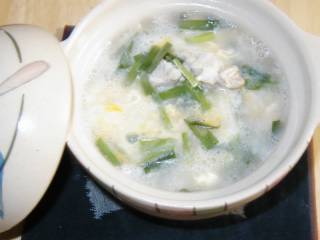
Rice Porridge


Don't burn your tongue!

This was my supper yesterday. It got unbelievably chilly last night after the typhoon passed. After spending some time in the heavy rain in the late afternoon, I felt very cold and tired when I got home. Maybe catching a cold? So I decided to make the rice porridge that I usually eat when I have a cold. To this special porridge, I put chicken, egg, and a lot of Chinese chive. For seasoning, I used instant dashi stock and soy sauce.

This small earthen pot or donabe is my favorite one. It’s a special donabe for porridge-making (for one serving). See? The top can be used as a rice bowl.

Cute, isn’t it?

One question: Are Chinese chive and leek the same thing?